

Climate and Drought in Turkey
Murat Turkes
Abstract The aim of this section of the book is to make a scientific synthesis of the
climate of Turkey along with the aridity and drought conditions, in a contemporary
physical geographical, hydro-climatological and meteorological approach. The
Mediterranean macroclimate, including much of Turkish territory, mainly results
from the seasonal alternation between mid-latitude frontal cyclones associated with
polar air masses during the winter, the subtropical high pressure systems link to
subsiding maritime tropical air mass over the mid-north Atlantic, and the continental
tropical air masses over the Northern Africa during the summer. In addition to these
pressure and circulation conditions, the north-western surface and/or circulationbased
extensions of the Asiatic monsoonal low pressure system cause generally very
dry and hot conditions over the Eastern Mediterranean and the Middle East regions,
including the southern and central parts of Turkey. According to the Köppen-Geiger
climate classification, the southern and western portions (Marmara, Aegean, Mediterranean
and South-eastern Anatolia regions) of Turkey are characterized mainly
with the dry summer sub-tropical Mediterranean climate (Csa). All of these regions
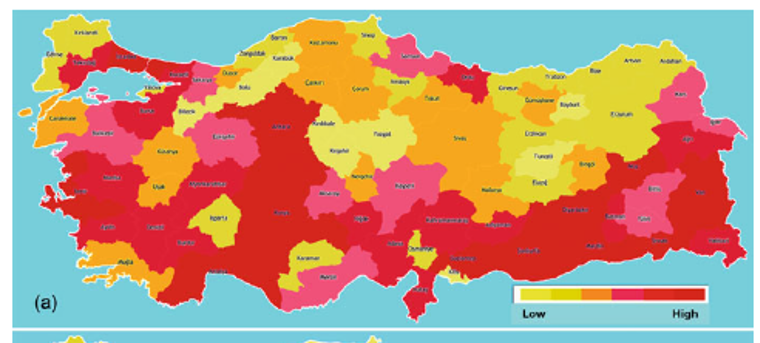
are also influenced by mid-to-high degree drought probability and drought risk,
while the Black Sea Region is characterized with a mid-latitude temperate climate
with a low-level drought probability and risk. The probabilities of being extremelydry
evidently indicate maximum values on the coast of Mediterranean Sea and over
the border zone between Turkey and Syria with a highest probability of about 0.27.
Continental steppe and cold snowy climates are dominated over most of the Central
and Eastern Anatolia regions.
Keywords Mediterranean and Turkey climates · North Atlantic oscillation ·
Composite precipitation anomalies and 500 hpa anomalous circulations · Drylands ·
Drought probability · Vulnerability/risk of Turkey
To read the full article, please click on
/wp-content/uploads/2026/07/Climate%20and%20Drought%20in%20Turkey.pdf
^
Climate and Drought in Turkey
Murat Turkes
Abstract The aim of this section of the book is to make a scientific synthesis of the
climate of Turkey along with the aridity and drought conditions, in a contemporary
physical geographical, hydro-climatological and meteorological approach. The
Mediterranean macroclimate, including much of Turkish territory, mainly results
from the seasonal alternation between mid-latitude frontal cyclones associated with
polar air masses during the winter, the subtropical high pressure systems link to
subsiding maritime tropical air mass over the mid-north Atlantic, and the continental
tropical air masses over the Northern Africa during the summer. In addition to these
pressure and circulation conditions, the north-western surface and/or circulationbased
extensions of the Asiatic monsoonal low pressure system cause generally very
dry and hot conditions over the Eastern Mediterranean and the Middle East regions,
including the southern and central parts of Turkey. According to the Köppen-Geiger
climate classification, the southern and western portions (Marmara, Aegean, Mediterranean
and South-eastern Anatolia regions) of Turkey are characterized mainly
with the dry summer sub-tropical Mediterranean climate (Csa). All of these regions
are also influenced by mid-to-high degree drought probability and drought risk,
while the Black Sea Region is characterized with a mid-latitude temperate climate
with a low-level drought probability and risk. The probabilities of being extremelydry
evidently indicate maximum values on the coast of Mediterranean Sea and over
the border zone between Turkey and Syria with a highest probability of about 0.27.
Continental steppe and cold snowy climates are dominated over most of the Central
and Eastern Anatolia regions.
Keywords Mediterranean and Turkey climates · North Atlantic oscillation ·
Composite precipitation anomalies and 500 hpa anomalous circulations · Drylands ·
Drought probability · Vulnerability/risk of Turkey
To read the full article, please click on
/wp-content/uploads/2026/07/Climate%20and%20Drought%20in%20Turkey.pdf
^
