
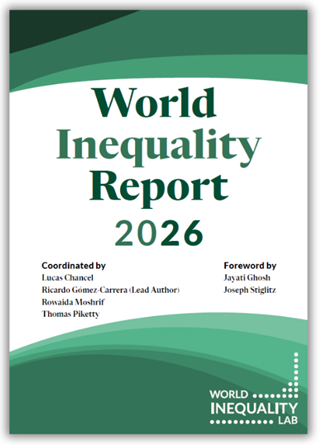

World Inequality Report 2026
November 4, 2025
Written by WID.world
On December 10, 2025, the World Inequality Lab will release the World Inequality Report 2026 wir2026.wid.world. Edited by Lucas Chancel, Ricardo Gómez-Carrera, Rowaida Moshrif, and Thomas Piketty, this report will offer the most up-to-date synthesis of international research efforts to track global inequalities
Prefaced by Jayati Ghosh and Joseph Stiglitz, this new report is launched in the context of the South African G20 presidency, which shone a spotlight on two major crises: the explosion of global inequalities and the weakening of multilateralism. The report reveals that inequality remains extreme and persistent—especially wealth inequality, which now threatens both climate action and democracy. The report explores the new dimensions of inequality that define the 21st century: climate, gender inequalities, unequal access to human capital, asymmetries in the global financial system, and territorial divides that are reshaping democracies.
Since 2018, the World Inequality Reports have shaped the international public debate on inequality. In eight chapters, this third edition offers a toolbox for understanding today’s inequality dynamics:
- A historical and multidimensional analysis of inequalities based on the most recent data collected by more than 200 researchers affiliated with the World Inequality Database
- Forty country sheets to explore and compare key indicators across countries and regions
- Context and insight into the proposals feeding public debate, such as a minimum wealth tax or the creation of an independent panel on inequalities—an idea already put forward in the Stiglitz report commissioned by the South African G20 presidency.
PRESS CONTACT
A press conference is organized on Thursday 4 December 2025, 16:00 CET, 15:00 GMT, 10:00 EST. To register or to receive an embargoed version of the report, please contact: Alice Fauvel, Communications Manager, alice.fauvel[at]psemail.eu
QUOTES
Ricardo Gómez-Carrera, Lead author of the report, said:
“Inequality is silent until it becomes scandalous. This report gives voice to inequality — and to the billions of people whose opportunities are frustrated by today’s unequal social and economic structures.”
Thomas Piketty, Co-Director of the World Inequality Lab, noted:
“The World Inequality Report 2026 comes at a challenging political time, but it is more essential than ever. Only by continuing the historic movement toward equality will we be able to address the social and climate challenges of the coming decades.”
Rowaida Moshrif, Co-Director of the World Inequality Lab, stressed:
“The World Inequality Report 2026 shows that inequality is not inevitable, it is shaped by choices, institutions, and power. In a world marked by economic, gender, and climate inequalities, it offers a framework for understanding these interconnections and a call to act: to rebuild solidarity, renew trust in democracy, and share prosperity more fairly across societies.”
Lucas Chancel, Co-Director of the World Inequality Lab, explained:
“Extreme inequalities are unsustainable — for our societies and for our ecosystems. Based on four years of work by over 200 researchers on every continent, this report offers a toolbox to inform public debate, to grasp how economic, social and ecological inequalities evolve and intersect — and to drive action.”
Gabriel Zucman, Scientific Co-Director of the World Inequality Lab, added:
“The World Inequality Report 2026 is an outstanding achievement: the definitive resource to monitor the evolution of inequality globally, in all its dimensions. It is a true global public good and a vital input for the public conversation throughout the world. We should all be immensely thankful to its authors who are doing such a service by disseminating this knowledge, for the benefit of all.”
Emmanuel Saez, Scientific Co-Director of the World Inequality Lab, added:
“At a time of growing inequality around the world, the World Inequality Report 2026 provides an invaluable source of information to help us understand the latest developments and put them in historical perspective. The report provides a rich set of measures, including not only income and wealth, but also gender disparities, regional inequality, and political cleavages within countries. All these facets of inequality are connected and will shape the evolution of our societies. Read the report to understand the facts and participate in the policy debate of what to do about it.”
Joseph E. Stiglitz, Nobel prize laureate and lead member of the G20 Extraordinary Committee of Independent Experts on Global Inequality, said:
“History, experiences across countries, and theory all show that today’s extreme inequality is not inevitable. Progressive taxation, strong social investment, fair labor standards, and democratic institutions have narrowed gaps in the past—and can do so again. The World Inequality Report provides the empirical foundation and intellectual framework for what can be done.”
Jayati Ghosh, member of the G20 Extraordinary Committee of Independent Experts on Global Inequality, said:
“We live in a system where resources extracted from labor and nature in low-income countries continue to sustain the prosperity and the unsustainable lifestyle of people in high-income economies and rich elites across countries. These patterns are not accidents of markets. They reflect the legacy of history and the functioning of institutions, regulations and policies—all of which are related to unequal power relations that have yet to be rebalanced.”
Joseph E. Stiglitz and Jayati Ghosh, stressed :
“An International Panel on Inequality is needed to track inequality worldwide, consider the drivers of inequality and provide objective, evidence-based recommendations for policymakers. The World Inequality Lab is an important example of such work and the way forward.”
Source: https://wid.world/news-article/world-inequality-report-2026-coming-out-soon/
^
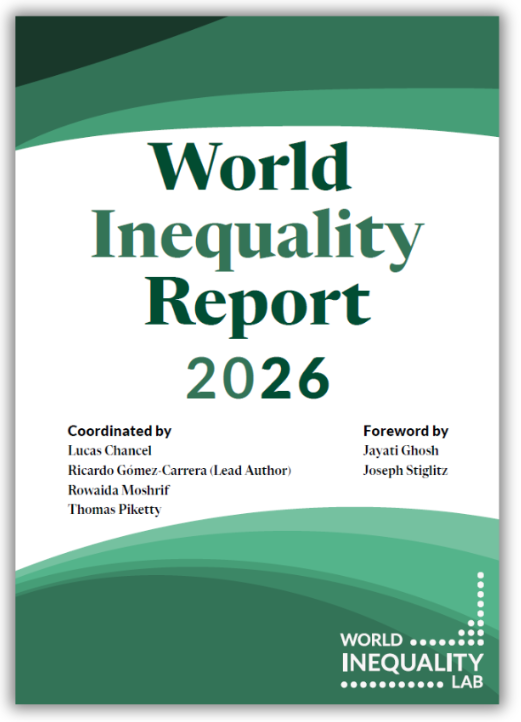
World Inequality Report 2026
November 4, 2025
Written by WID.world
On December 10, 2025, the World Inequality Lab will release the World Inequality Report 2026 wir2026.wid.world. Edited by Lucas Chancel, Ricardo Gómez-Carrera, Rowaida Moshrif, and Thomas Piketty, this report will offer the most up-to-date synthesis of international research efforts to track global inequalities
Prefaced by Jayati Ghosh and Joseph Stiglitz, this new report is launched in the context of the South African G20 presidency, which shone a spotlight on two major crises: the explosion of global inequalities and the weakening of multilateralism. The report reveals that inequality remains extreme and persistent—especially wealth inequality, which now threatens both climate action and democracy. The report explores the new dimensions of inequality that define the 21st century: climate, gender inequalities, unequal access to human capital, asymmetries in the global financial system, and territorial divides that are reshaping democracies.
Since 2018, the World Inequality Reports have shaped the international public debate on inequality. In eight chapters, this third edition offers a toolbox for understanding today’s inequality dynamics:
- A historical and multidimensional analysis of inequalities based on the most recent data collected by more than 200 researchers affiliated with the World Inequality Database
- Forty country sheets to explore and compare key indicators across countries and regions
- Context and insight into the proposals feeding public debate, such as a minimum wealth tax or the creation of an independent panel on inequalities—an idea already put forward in the Stiglitz report commissioned by the South African G20 presidency.
PRESS CONTACT
A press conference is organized on Thursday 4 December 2025, 16:00 CET, 15:00 GMT, 10:00 EST. To register or to receive an embargoed version of the report, please contact: Alice Fauvel, Communications Manager, alice.fauvel[at]psemail.eu
QUOTES
Ricardo Gómez-Carrera, Lead author of the report, said:
“Inequality is silent until it becomes scandalous. This report gives voice to inequality — and to the billions of people whose opportunities are frustrated by today’s unequal social and economic structures.”
Thomas Piketty, Co-Director of the World Inequality Lab, noted:
“The World Inequality Report 2026 comes at a challenging political time, but it is more essential than ever. Only by continuing the historic movement toward equality will we be able to address the social and climate challenges of the coming decades.”
Rowaida Moshrif, Co-Director of the World Inequality Lab, stressed:
“The World Inequality Report 2026 shows that inequality is not inevitable, it is shaped by choices, institutions, and power. In a world marked by economic, gender, and climate inequalities, it offers a framework for understanding these interconnections and a call to act: to rebuild solidarity, renew trust in democracy, and share prosperity more fairly across societies.”
Lucas Chancel, Co-Director of the World Inequality Lab, explained:
“Extreme inequalities are unsustainable — for our societies and for our ecosystems. Based on four years of work by over 200 researchers on every continent, this report offers a toolbox to inform public debate, to grasp how economic, social and ecological inequalities evolve and intersect — and to drive action.”
Gabriel Zucman, Scientific Co-Director of the World Inequality Lab, added:
“The World Inequality Report 2026 is an outstanding achievement: the definitive resource to monitor the evolution of inequality globally, in all its dimensions. It is a true global public good and a vital input for the public conversation throughout the world. We should all be immensely thankful to its authors who are doing such a service by disseminating this knowledge, for the benefit of all.”
Emmanuel Saez, Scientific Co-Director of the World Inequality Lab, added:
“At a time of growing inequality around the world, the World Inequality Report 2026 provides an invaluable source of information to help us understand the latest developments and put them in historical perspective. The report provides a rich set of measures, including not only income and wealth, but also gender disparities, regional inequality, and political cleavages within countries. All these facets of inequality are connected and will shape the evolution of our societies. Read the report to understand the facts and participate in the policy debate of what to do about it.”
Joseph E. Stiglitz, Nobel prize laureate and lead member of the G20 Extraordinary Committee of Independent Experts on Global Inequality, said:
“History, experiences across countries, and theory all show that today’s extreme inequality is not inevitable. Progressive taxation, strong social investment, fair labor standards, and democratic institutions have narrowed gaps in the past—and can do so again. The World Inequality Report provides the empirical foundation and intellectual framework for what can be done.”
Jayati Ghosh, member of the G20 Extraordinary Committee of Independent Experts on Global Inequality, said:
“We live in a system where resources extracted from labor and nature in low-income countries continue to sustain the prosperity and the unsustainable lifestyle of people in high-income economies and rich elites across countries. These patterns are not accidents of markets. They reflect the legacy of history and the functioning of institutions, regulations and policies—all of which are related to unequal power relations that have yet to be rebalanced.”
Joseph E. Stiglitz and Jayati Ghosh, stressed :
“An International Panel on Inequality is needed to track inequality worldwide, consider the drivers of inequality and provide objective, evidence-based recommendations for policymakers. The World Inequality Lab is an important example of such work and the way forward.”
Source: https://wid.world/news-article/world-inequality-report-2026-coming-out-soon/
^
