

Water demand is rising fast
Citizens, business and policy-makers must come together to address fast-rising water use.
The global water crisis threatens the well-being of billions of people and the stability of nations worldwide. Key drivers include unsustainable usage, climate change, pollution, lack of infrastructure, poverty, weak governance, and transboundary disputes. The multiple impacts span public health, food and energy security, economic growth, and geopolitical conflicts.
Water shortages hamper economic growth and worsen poverty. Hydroelectricity, manufacturing, mining, and other water-intensive industries suffer. The World Bank estimates that by 2050, water scarcity could cost some regions 6% of gross domestic product (GDP), entrenching inequality. Climate migration strains nations. Overall, water crises destabilize societies on many levels if left unaddressed.
Tackling the global water crisis requires both local and international initiatives across infrastructure, technology, governance, cooperation, education, and funding.
There is no silver bullet, but solutions are there for the taking; there is much we, as individuals, organizations and society, can achieve collectively. We can drive progress toward a sustainable future, where the supply of fresh water meets growing demand. We have the tools at our disposal to start to address water insecurity – now let’s gather the will to do so.
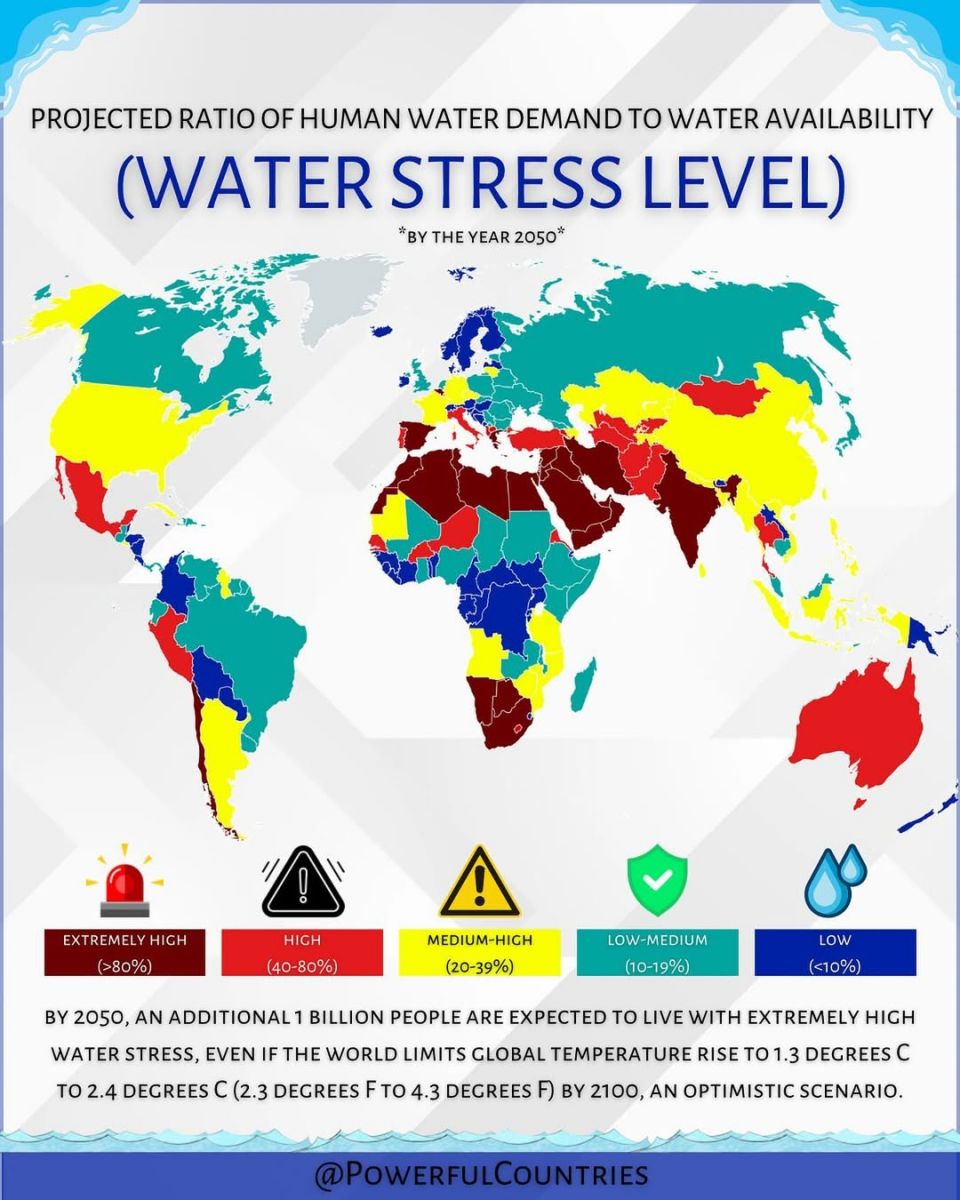
Across the world, demand for water is exceeding what’s available. Globally, demand has more than doubled since 1960.
Increased water demand is often the result of growing populations and industries like irrigated agriculture, livestock, energy production and manufacturing. Meanwhile, lack of investment in water infrastructure, unsustainable water use policies or increased variability due to climate change can all affect the available water supply.
Water stress, the ratio of water demand to renewable supply, measures the competition over local water resources. The smaller the gap between supply and demand, the more vulnerable a place is to water shortages. A country facing “extreme water stress” means it is using at least 80% of its available supply, “high water stress” means it is withdrawing 40% of its supply.
Without intervention — such as investment in water infrastructure and better water governance — water stress will continue to get worse, particularly in places with rapidly growing populations and economies.
•
Source(s): World Resources Institute
^
Water demand is rising fast
Citizens, business and policy-makers must come together to address fast-rising water use.
The global water crisis threatens the well-being of billions of people and the stability of nations worldwide. Key drivers include unsustainable usage, climate change, pollution, lack of infrastructure, poverty, weak governance, and transboundary disputes. The multiple impacts span public health, food and energy security, economic growth, and geopolitical conflicts.
Water shortages hamper economic growth and worsen poverty. Hydroelectricity, manufacturing, mining, and other water-intensive industries suffer. The World Bank estimates that by 2050, water scarcity could cost some regions 6% of gross domestic product (GDP), entrenching inequality. Climate migration strains nations. Overall, water crises destabilize societies on many levels if left unaddressed.
Tackling the global water crisis requires both local and international initiatives across infrastructure, technology, governance, cooperation, education, and funding.
There is no silver bullet, but solutions are there for the taking; there is much we, as individuals, organizations and society, can achieve collectively. We can drive progress toward a sustainable future, where the supply of fresh water meets growing demand. We have the tools at our disposal to start to address water insecurity – now let’s gather the will to do so.
Across the world, demand for water is exceeding what’s available. Globally, demand has more than doubled since 1960.
Increased water demand is often the result of growing populations and industries like irrigated agriculture, livestock, energy production and manufacturing. Meanwhile, lack of investment in water infrastructure, unsustainable water use policies or increased variability due to climate change can all affect the available water supply.
Water stress, the ratio of water demand to renewable supply, measures the competition over local water resources. The smaller the gap between supply and demand, the more vulnerable a place is to water shortages. A country facing “extreme water stress” means it is using at least 80% of its available supply, “high water stress” means it is withdrawing 40% of its supply.
Without intervention — such as investment in water infrastructure and better water governance — water stress will continue to get worse, particularly in places with rapidly growing populations and economies.
•
Source(s): World Resources Institute
^
