

The Population of Africa under the Conditions of Transformation of the World Order

Author information Article notes Copyright and License information PMC Disclaimer
Abramova, I. O. (2022). The Population of Africa under the Conditions of Transformation of the World Order. Herald of the Russian Academy of Sciences, 92(Suppl 14), S1306. https://doi.org/10.1134/S1019331622200023
Abstract
This article explores Africa’s role in the changing demographic picture of the world in the context of the global transformation of the world order, taking into account modern economic, social, and military challenges. Based on the analysis of current demographic trends, the author suggests that the center of global demographic growth has already largely shifted towards sub-Saharan Africa, where the population growth rates average 2.5% per year. Despite certain discrepancies in subregional and national trends, it is the African continent that, starting from 2035, will shape the dominating demographic trends on the planet and, to a large extent, determine the quantitative and qualitative structure of the future of the global labor market. This, in turn, will fundamentally change the structure of the world economy, since the mass consumer of a significant share of goods and services will be located not in the countries of the Global North, where the population will steadily decline, but in the Global South. This article reviews Africa’s main demographic indicators: birth rate, mortality, population growth rates, fertility, life expectancy, etc. The main economic and social factors affecting the dynamics of these indicators against the background of similar changes in other countries and regions of our planet are analyzed. As a result of this analysis, it is posited that Russia should developed a new system of foreign economic relations, focusing, among other things, on the rapidly growing market of goods, services, and labor of the African continent. The humanitarian sphere should become the most important area of cooperation. Russia is able to make a significant contribution to improving the quality of Africa’s human capital through the promotion of its educational and scientific schools and broad cooperation in the technological sphere.
Keywords: Africa, new world order, population, demographic growth, human capital, cooperation with Russia
INTRODUCTION
On November 15, 2022, the population of the Earth, according to the UN, exceeded eight billion people. At the same time, in the last 100–150 years, the growth rate of the world’s population has accelerated almost constantly, with the exception of periods of world wars and global pandemics. In the early 1900s, only 1.6 billion people lived on the planet; at the dawn of the 2000s, there were already six billion, and in 2011, seven billion.1 Such rapid growth is explained by a number of factors: the development of medicine, advances in sanitation, increased access to clean drinking water, widespread vaccination coverage, etc. All of the above factors ultimately have led to a reduction in mortality rates, primarily infant mortality, and to an increase in life expectancy in most countries of the world, which, while maintaining high birth rates in a number of states, contributed to the acceleration of population growth.
According to UN experts, despite the constant increase in the population, its growth rate has recently been slowing down. More than 60 countries are projected to experience a decline of 1% or more between 2022 and 2050 due to a persistently low birth rate and, in some cases, the outflow of the population to other countries.
More than half of the projected world population growth by 2050 will be concentrated in eight countries—the Democratic Republic of the Congo, Egypt, Ethiopia, India, Nigeria, Pakistan, the Philippines, and the United Republic of Tanzania. It is quite remarkable that five countries from this list are located on the African continent.
At the same time, the proportion of the world’s population aged 65 years and over is projected to rise from 10% in 2022 to 16% in 2050.
UN experts note that life expectancy in the world reached 73 years in 2020, which is almost nine years more than in 1990. It is predicted that further decline in mortality will lead to the fact that the average life expectancy in the world will exceed 77 years by 2050.
UN Secretary-General Antonio Guterres believes that reaching the eight billion milestone is a joyful event in the life of mankind, but at the same time it imposes a great responsibility on all countries and peoples to solve common humanitarian problems.2
The global transformation of the world order accelerated dramatically during the COVID-19 pandemic and especially after the start of the Special Military Operation. It affected all states, regions, and continents and all spheres of human activity—economics, politics, culture, science, social relations, and the information space. Growing epidemiological threats and a sharp increase in military tension have brought to the fore the question of the survival of mankind. Under these conditions, even if a biological and nuclear catastrophe is avoided, structural changes in the world economy and social sphere will be so profound that they will also affect the demographic behavior of the inhabitants of our planet. Another thing is that the latter, in comparison with the model of economic development, is much more inertial, since it is largely due to traditions and stereotypes that have been formed over the centuries. At the same time, in Western countries, where the traditional idea of the family is being destroyed rather quickly, one can predict an accelerated formation of a new type of demographic behavior with a minimum number of children or their complete absence, and in the future, no matter how fantastic this picture may seem, with a possible transition to genetic-engineering technologies for controlled reproduction of offspring with desired qualities.
Most of humanity is not yet ready for such a transition either technologically or morally. The institution of the traditional family still retains its significance not only in Russia, but also in most countries of Asia, Africa, and Latin America, and it is these regions of the global South that determine the demographic picture of the world today and in the coming decades.
DEMOGRAPHIC “UPS” AND “DOWNS”
Europe remains the most “vulnerable” region from a demographic point of view. So, for example, if the population of the Earth over the past 20 years has increased per year, on average, by 1.15%, then in European countries the growth rate in the number of inhabitants over the same period did not exceed 0.14%. Over the past two decades, the global population has grown by 742 million people, and the number of inhabitants of the Old World, by only 20 million, and then mainly due to migrants who received European passports.
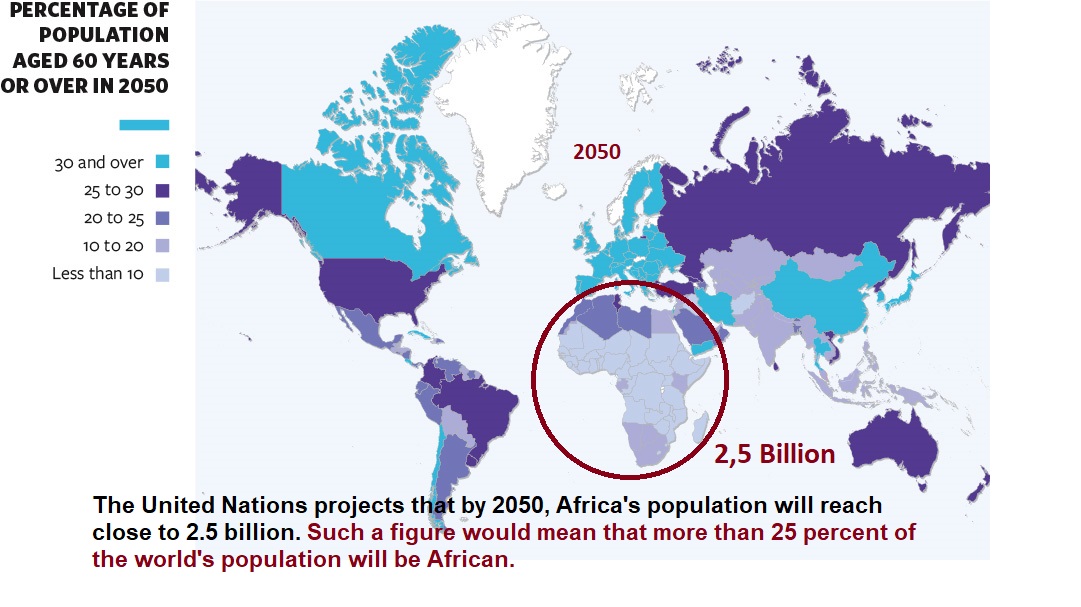
According to the UN, if current trends continue, by 2050 the European population will be reduced to about 700 million people, and by 2100 there will be fewer than 600 million inhabitants on the continent. In addition, Europe will lose approximately 30 million people of working age by 2050.3 This is already a serious blow to the labor market, which can only be compensated by migrants, which is also associated with a whole bunch of social, cultural, and religious problems, as well as a decrease in the educational and qualification level of workers. In 2022, the share of Europe and North America in the world population was 14.1%. According to UN forecasts, by 2030 the number of inhabitants of these regions will increase by only nine million people, and its share in the world population will decrease to 13.2%. An even more interesting picture is predicted by 2050: the population of the United States, Canada, and Europe will decrease by four million and will amount to only 1.125 billion people, or just over 11% of the inhabitants of our planet.4
Quite a different situation is observed in the countries of Asia, Africa, and Latin America. The average annual rate of population growth in this group of countries from 1990 to 2020 was 1.7%, i.e., 5.5 times higher than in developed countries. It is developing countries that currently provide 98% of world population growth, and in the next 15 years, their contribution will reach 100%.5
As seen from Table 1, in 2021, 2.8 billion people, or 36% of the global population, lived in India and China. In recent decades, the main increase in the world’s population has been provided mainly by these demographic giants. However, recently the situation has changed. China, which has been pursuing a policy of “One family, one child” for a long time, managed to reduce the population growth rate to 0.1% by 2021, although back in 2010 they were at the level of 0.5% per year. In India, this indicator continues to be quite high, at the level of 1.4% (in 2010, it was 1.6%).
to read the full article please click on
^
The Population of Africa under the Conditions of Transformation of the World Order
Author information Article notes Copyright and License information PMC Disclaimer
Abramova, I. O. (2022). The Population of Africa under the Conditions of Transformation of the World Order. Herald of the Russian Academy of Sciences, 92(Suppl 14), S1306. https://doi.org/10.1134/S1019331622200023
Abstract
This article explores Africa’s role in the changing demographic picture of the world in the context of the global transformation of the world order, taking into account modern economic, social, and military challenges. Based on the analysis of current demographic trends, the author suggests that the center of global demographic growth has already largely shifted towards sub-Saharan Africa, where the population growth rates average 2.5% per year. Despite certain discrepancies in subregional and national trends, it is the African continent that, starting from 2035, will shape the dominating demographic trends on the planet and, to a large extent, determine the quantitative and qualitative structure of the future of the global labor market. This, in turn, will fundamentally change the structure of the world economy, since the mass consumer of a significant share of goods and services will be located not in the countries of the Global North, where the population will steadily decline, but in the Global South. This article reviews Africa’s main demographic indicators: birth rate, mortality, population growth rates, fertility, life expectancy, etc. The main economic and social factors affecting the dynamics of these indicators against the background of similar changes in other countries and regions of our planet are analyzed. As a result of this analysis, it is posited that Russia should developed a new system of foreign economic relations, focusing, among other things, on the rapidly growing market of goods, services, and labor of the African continent. The humanitarian sphere should become the most important area of cooperation. Russia is able to make a significant contribution to improving the quality of Africa’s human capital through the promotion of its educational and scientific schools and broad cooperation in the technological sphere.
Keywords: Africa, new world order, population, demographic growth, human capital, cooperation with Russia
INTRODUCTION
On November 15, 2022, the population of the Earth, according to the UN, exceeded eight billion people. At the same time, in the last 100–150 years, the growth rate of the world’s population has accelerated almost constantly, with the exception of periods of world wars and global pandemics. In the early 1900s, only 1.6 billion people lived on the planet; at the dawn of the 2000s, there were already six billion, and in 2011, seven billion.1 Such rapid growth is explained by a number of factors: the development of medicine, advances in sanitation, increased access to clean drinking water, widespread vaccination coverage, etc. All of the above factors ultimately have led to a reduction in mortality rates, primarily infant mortality, and to an increase in life expectancy in most countries of the world, which, while maintaining high birth rates in a number of states, contributed to the acceleration of population growth.
According to UN experts, despite the constant increase in the population, its growth rate has recently been slowing down. More than 60 countries are projected to experience a decline of 1% or more between 2022 and 2050 due to a persistently low birth rate and, in some cases, the outflow of the population to other countries.
More than half of the projected world population growth by 2050 will be concentrated in eight countries—the Democratic Republic of the Congo, Egypt, Ethiopia, India, Nigeria, Pakistan, the Philippines, and the United Republic of Tanzania. It is quite remarkable that five countries from this list are located on the African continent.
At the same time, the proportion of the world’s population aged 65 years and over is projected to rise from 10% in 2022 to 16% in 2050.
UN experts note that life expectancy in the world reached 73 years in 2020, which is almost nine years more than in 1990. It is predicted that further decline in mortality will lead to the fact that the average life expectancy in the world will exceed 77 years by 2050.
UN Secretary-General Antonio Guterres believes that reaching the eight billion milestone is a joyful event in the life of mankind, but at the same time it imposes a great responsibility on all countries and peoples to solve common humanitarian problems.2
The global transformation of the world order accelerated dramatically during the COVID-19 pandemic and especially after the start of the Special Military Operation. It affected all states, regions, and continents and all spheres of human activity—economics, politics, culture, science, social relations, and the information space. Growing epidemiological threats and a sharp increase in military tension have brought to the fore the question of the survival of mankind. Under these conditions, even if a biological and nuclear catastrophe is avoided, structural changes in the world economy and social sphere will be so profound that they will also affect the demographic behavior of the inhabitants of our planet. Another thing is that the latter, in comparison with the model of economic development, is much more inertial, since it is largely due to traditions and stereotypes that have been formed over the centuries. At the same time, in Western countries, where the traditional idea of the family is being destroyed rather quickly, one can predict an accelerated formation of a new type of demographic behavior with a minimum number of children or their complete absence, and in the future, no matter how fantastic this picture may seem, with a possible transition to genetic-engineering technologies for controlled reproduction of offspring with desired qualities.
Most of humanity is not yet ready for such a transition either technologically or morally. The institution of the traditional family still retains its significance not only in Russia, but also in most countries of Asia, Africa, and Latin America, and it is these regions of the global South that determine the demographic picture of the world today and in the coming decades.
DEMOGRAPHIC “UPS” AND “DOWNS”
Europe remains the most “vulnerable” region from a demographic point of view. So, for example, if the population of the Earth over the past 20 years has increased per year, on average, by 1.15%, then in European countries the growth rate in the number of inhabitants over the same period did not exceed 0.14%. Over the past two decades, the global population has grown by 742 million people, and the number of inhabitants of the Old World, by only 20 million, and then mainly due to migrants who received European passports.
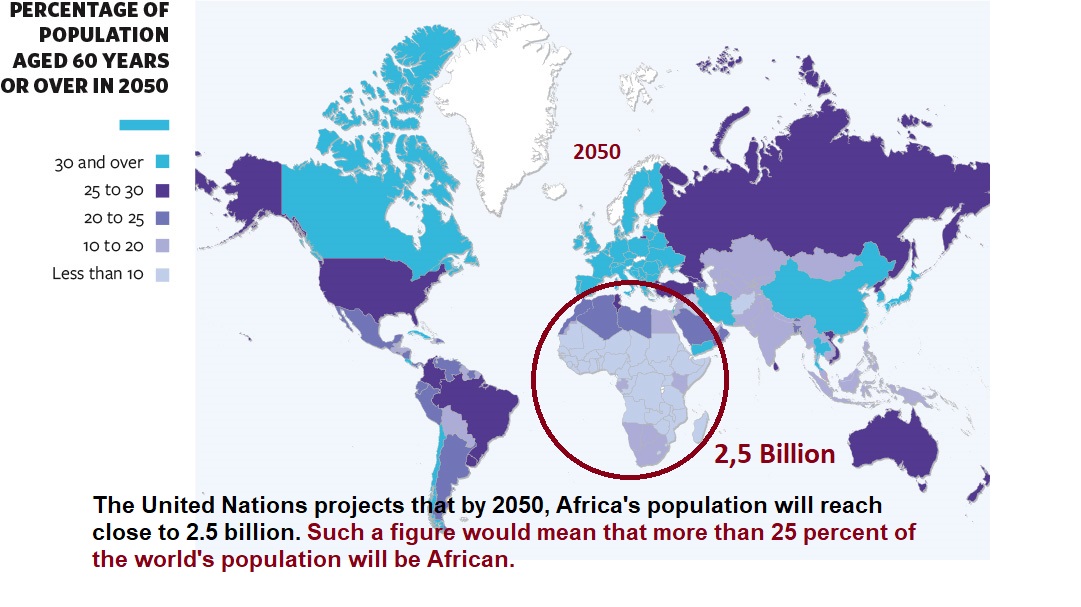
According to the UN, if current trends continue, by 2050 the European population will be reduced to about 700 million people, and by 2100 there will be fewer than 600 million inhabitants on the continent. In addition, Europe will lose approximately 30 million people of working age by 2050.3 This is already a serious blow to the labor market, which can only be compensated by migrants, which is also associated with a whole bunch of social, cultural, and religious problems, as well as a decrease in the educational and qualification level of workers. In 2022, the share of Europe and North America in the world population was 14.1%. According to UN forecasts, by 2030 the number of inhabitants of these regions will increase by only nine million people, and its share in the world population will decrease to 13.2%. An even more interesting picture is predicted by 2050: the population of the United States, Canada, and Europe will decrease by four million and will amount to only 1.125 billion people, or just over 11% of the inhabitants of our planet.4
Quite a different situation is observed in the countries of Asia, Africa, and Latin America. The average annual rate of population growth in this group of countries from 1990 to 2020 was 1.7%, i.e., 5.5 times higher than in developed countries. It is developing countries that currently provide 98% of world population growth, and in the next 15 years, their contribution will reach 100%.5
As seen from Table 1, in 2021, 2.8 billion people, or 36% of the global population, lived in India and China. In recent decades, the main increase in the world’s population has been provided mainly by these demographic giants. However, recently the situation has changed. China, which has been pursuing a policy of “One family, one child” for a long time, managed to reduce the population growth rate to 0.1% by 2021, although back in 2010 they were at the level of 0.5% per year. In India, this indicator continues to be quite high, at the level of 1.4% (in 2010, it was 1.6%).
to read the full article please click on
^
