
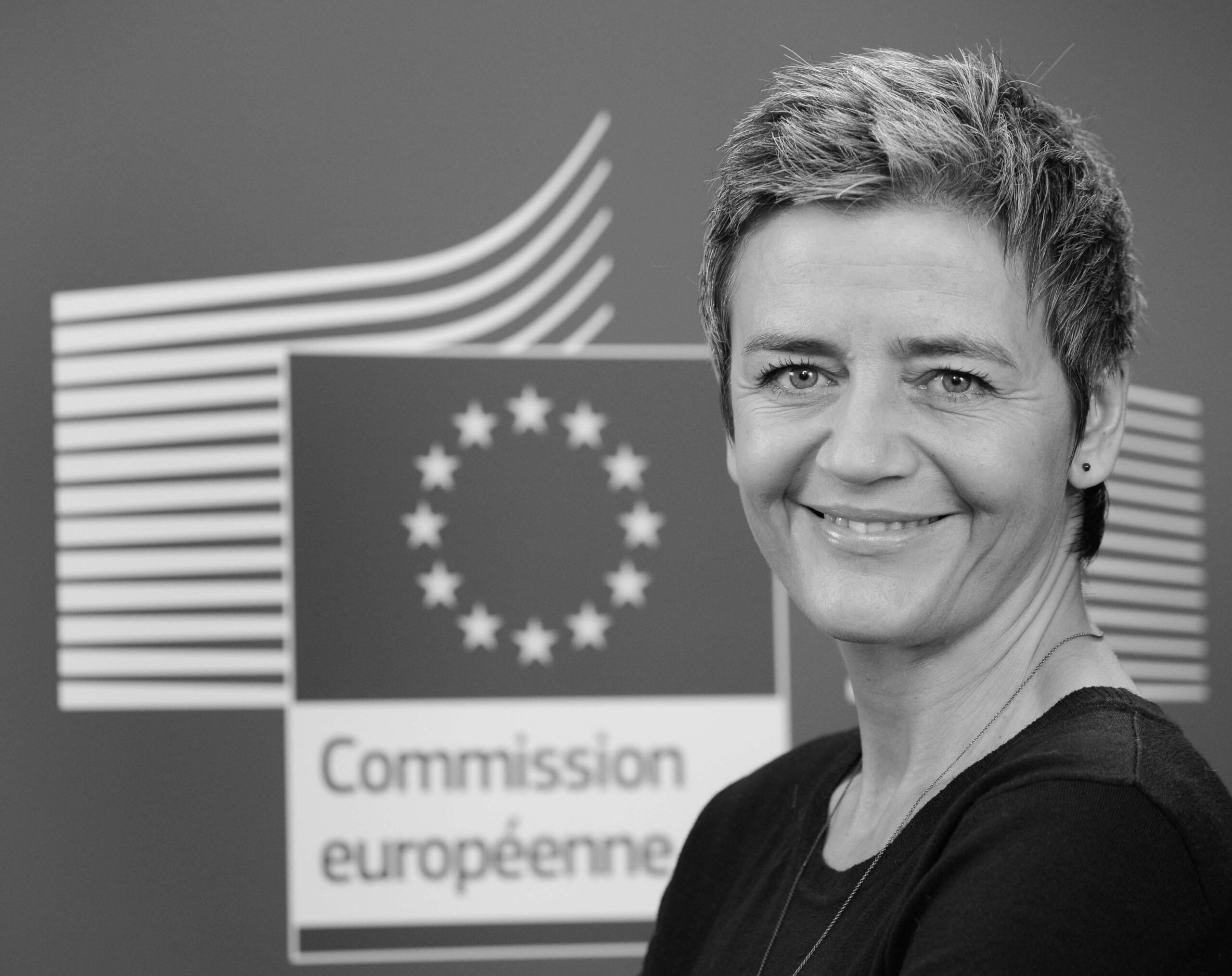

Speech by Executive Vice President Vestager on technology and politics at
the Institute for Advanced Study
Brussels, 9 April 2024
Introduction
Good morning. It is a true honour to address you here today. A true honour to walk in the steps of
some of this world’s most illustrious thinkers. Along Fuld Hall, all the way to this room, where many
of them gave lectures that changed the course of time.
Albert Einstein, John von Neumann, Hetty Goldman, among others… And of course, Julius Robert
Oppenheimer. The very Oppenheimer that directed this institute, and set history on a new course
with his contribution to nuclear science. And these days probably the world’s most famous
theoretical physicist .
Oppenheimer owes a large part of his revived fame across the world, to Christopher Nolan’s amazing
talent as a movie director. Seven Oscars are enough to prove it. But I guess the truth is the other
way around. Nolan’s movie owes a large part of its success to Oppenheimer himself – his complex, at
times puzzling personality.
Julius Robert Oppenheimer was a scientist. But more, he was a humanist. One of the first science
men to have asserted that technology and humanity can only go together. That’s a very modern
thought, at a not-so-modern time.
Before many others, Oppenheimer understood that some technologies do not simply add something
to the world. They change it completely. I guess this is what my countryman Niels Bohr means when
in the movie, he tells Oppenheimer: “this is not a new weapon, it is a new world”.
The nuclear weapon did not just add-up to traditional warfare. It completely changed the stakes of
traditional war. It triggered the need for international cooperation, just because the cost of not doing
so would simply be too big for anyone to contemplate.
Now fast-forward eighty years. Today, digital technologies do not only add new ways for us to learn,
to buy, to create, or keep in touch. Digital technologies change the world as we know it. And I see
three ways this is happening, in particular:
First – with the dominance of large digital platforms, technology is challenging democracy.
Second – with the rise of General Purpose Artificial Intelligence, technology is challenging
humanity.
And third – with the global race for the technologies we need the most, technology is
challenging our economic security. And shaping a new geopolitical world order.
to read the full speech please click on
^
Speech by Executive Vice President Vestager on technology and politics at
the Institute for Advanced Study
Brussels, 9 April 2024
Introduction
Good morning. It is a true honour to address you here today. A true honour to walk in the steps of
some of this world’s most illustrious thinkers. Along Fuld Hall, all the way to this room, where many
of them gave lectures that changed the course of time.
Albert Einstein, John von Neumann, Hetty Goldman, among others… And of course, Julius Robert
Oppenheimer. The very Oppenheimer that directed this institute, and set history on a new course
with his contribution to nuclear science. And these days probably the world’s most famous
theoretical physicist .
Oppenheimer owes a large part of his revived fame across the world, to Christopher Nolan’s amazing
talent as a movie director. Seven Oscars are enough to prove it. But I guess the truth is the other
way around. Nolan’s movie owes a large part of its success to Oppenheimer himself – his complex, at
times puzzling personality.
Julius Robert Oppenheimer was a scientist. But more, he was a humanist. One of the first science
men to have asserted that technology and humanity can only go together. That’s a very modern
thought, at a not-so-modern time.
Before many others, Oppenheimer understood that some technologies do not simply add something
to the world. They change it completely. I guess this is what my countryman Niels Bohr means when
in the movie, he tells Oppenheimer: “this is not a new weapon, it is a new world”.
The nuclear weapon did not just add-up to traditional warfare. It completely changed the stakes of
traditional war. It triggered the need for international cooperation, just because the cost of not doing
so would simply be too big for anyone to contemplate.
Now fast-forward eighty years. Today, digital technologies do not only add new ways for us to learn,
to buy, to create, or keep in touch. Digital technologies change the world as we know it. And I see
three ways this is happening, in particular:
First – with the dominance of large digital platforms, technology is challenging democracy.
Second – with the rise of General Purpose Artificial Intelligence, technology is challenging
humanity.
And third – with the global race for the technologies we need the most, technology is
challenging our economic security. And shaping a new geopolitical world order.
to read the full speech please click on
^
