

Higher atmospheric aridity-dominated drought stress contributes to aggravating dryland productivity loss under global warming
Xiaojing Yu a,b, Lixia Zhang c,b,*, Tianjun Zhou c,d, Jianghua Zheng a, Jingyun Guan e
a College of Geography and Remote Sensing Sciences, Xinjiang University, 830017 Urumqi, China
b Collaborative Innovation Center on Forecast and Evaluation of Meteorological Disasters, Nanjing University of Information Science and Technology, 210044, Nanjing, China
c State Key Laboratory of Numerical Modeling for Atmospheric Sciences and Geophysical Fluid Dynamics (LASG), Institute of Atmospheric Physics, Chinese Academy of Sciences, 10029, Beijing, China
d University of Chinese Academy of Sciences, 10049, Beijing, China
e College of Tourism, Xinjiang University of Finance and Economics, 830012, Urumqi, China
Keywords: Drought stress High vapor pressure deficit (VPD) Dryland productivity CMIP6 projections Global warming
A B S T R A C T
Dryland ecosystems are highly vulnerable to extreme droughts under climate change. Yet, response of vegetation
productivity across global drylands to changes in drought stress in a warming climate remains obscure. Here, we
investigated future changes in drought stress, characterized by low soil moisture (SM) and high vapor pressure
deficit (VPD), under severe drought conditions and its impact on gross primary productivity (GPP) deviations in
drylands, based on the Coupled Model Intercomparison Project Phase 6 (CMIP6) Earth system model (ESM)
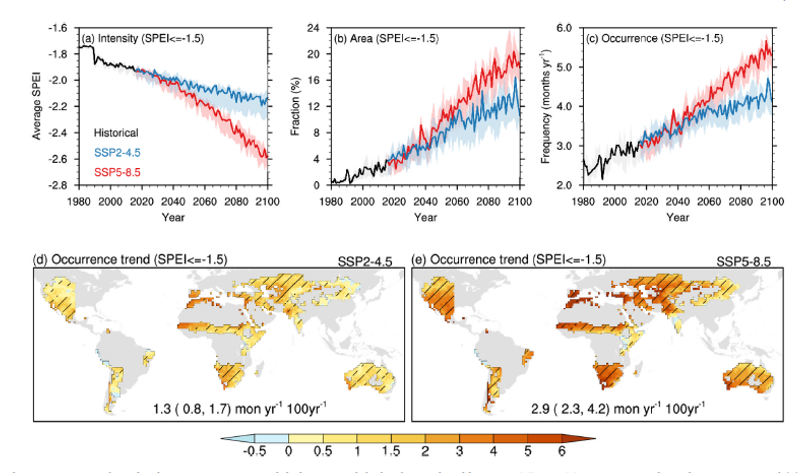
simulations. Under both intermediate (SSP2-4.5) and high (SSP5-8.5) emission scenarios, the dryland ecosystems
are projected to experience more intense, extensive and frequent severe drought events owing to increasing VPD.
The probabilities of high VPD-dominated drought stress in the end of the 21st century would be nearly double
(2.1–2.4 times) of the present-day (39%). Excluding the carbon dioxide (CO2) fertilization effect, the annual GPP
loss caused by severe drought is projected to further deteriorate over more than half fraction (56.9–70.9%) of
global vegetated dryland areas, reaching 2.0 (1.9–2.2) times of the present-day (with an area-weighted total of
to read the full article please click on
^
Higher atmospheric aridity-dominated drought stress contributes to aggravating dryland productivity loss under global warming
Xiaojing Yu a,b, Lixia Zhang c,b,*, Tianjun Zhou c,d, Jianghua Zheng a, Jingyun Guan e
a College of Geography and Remote Sensing Sciences, Xinjiang University, 830017 Urumqi, China
b Collaborative Innovation Center on Forecast and Evaluation of Meteorological Disasters, Nanjing University of Information Science and Technology, 210044, Nanjing, China
c State Key Laboratory of Numerical Modeling for Atmospheric Sciences and Geophysical Fluid Dynamics (LASG), Institute of Atmospheric Physics, Chinese Academy of Sciences, 10029, Beijing, China
d University of Chinese Academy of Sciences, 10049, Beijing, China
e College of Tourism, Xinjiang University of Finance and Economics, 830012, Urumqi, China
Keywords: Drought stress High vapor pressure deficit (VPD) Dryland productivity CMIP6 projections Global warming
A B S T R A C T
Dryland ecosystems are highly vulnerable to extreme droughts under climate change. Yet, response of vegetation
productivity across global drylands to changes in drought stress in a warming climate remains obscure. Here, we
investigated future changes in drought stress, characterized by low soil moisture (SM) and high vapor pressure
deficit (VPD), under severe drought conditions and its impact on gross primary productivity (GPP) deviations in
drylands, based on the Coupled Model Intercomparison Project Phase 6 (CMIP6) Earth system model (ESM)
simulations. Under both intermediate (SSP2-4.5) and high (SSP5-8.5) emission scenarios, the dryland ecosystems
are projected to experience more intense, extensive and frequent severe drought events owing to increasing VPD.
The probabilities of high VPD-dominated drought stress in the end of the 21st century would be nearly double
(2.1–2.4 times) of the present-day (39%). Excluding the carbon dioxide (CO2) fertilization effect, the annual GPP
loss caused by severe drought is projected to further deteriorate over more than half fraction (56.9–70.9%) of
global vegetated dryland areas, reaching 2.0 (1.9–2.2) times of the present-day (with an area-weighted total of
to read the full article please click on
^
