


19 JUNE 2019 Mervyn Piesse,
Research Manager,
Global Food and Water Crises Research Programme
Background
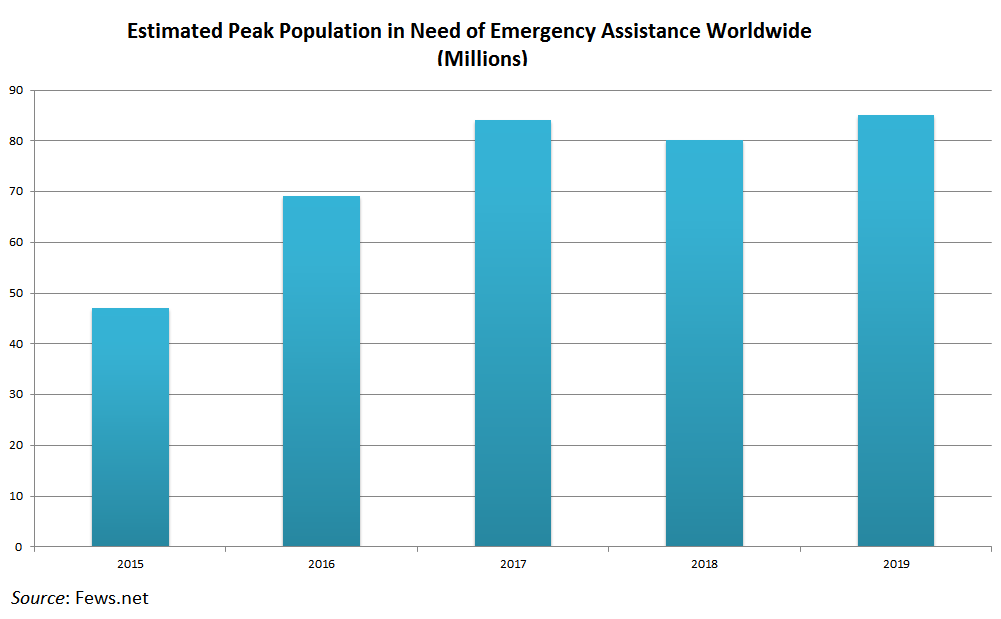
South Sudan, Yemen and the Horn of Africa remain as the areas of greatest concern to food and water security monitoring agencies, due to their poor economic and food production conditions, which are often exacerbated by ongoing conflict. Across the world, 85 million people are expected to require emergency food assistance in 2019, an 80 per cent increase compared to 2015.
Comment
By some accounts, the last two rainy seasons in the Horn of Africa were the driest in more than 30 years. The region has two distinct rainy seasons: the Deyr season that occurs between October and December and the Gu season that occurs between April and June.
A previous Strategic Analysis Paper suggested that severe food and water insecurity could become the normal state of affairs in the Horn. While the region has always suffered from weak food and water security, it seems that severe food and water insecurity is now occurring with greater regularity. If that is the case, it will become increasingly difficult for the most vulnerable people to recover from lean times before those conditions return.
Parts of East Africa suffered from severe food and water insecurity in 2010-11 and 2016-17. In the latter season, the Horn of Africa received rainfall that was less than 30 per cent of the average. As a result, Somalian cereal production in 2016-17 was 70 per cent lower than the 20-year average and a national drought was declared in Kenya. The region has not fully recovered from that dry period and, due to the adverse conditions in late 2018, many households depleted their food stocks earlier than usual. As the 2019 rainy season also failed, there will be very little opportunity for them to replenish their food stocks ahead of the next lean season.
More than 60 per cent of the South Sudanese population (about seven million people) is likely to face a food security crisis in 2019, the largest proportion of the country to ever face those conditions. While it is not unusual for that country to experience heightened food insecurity during the lean season, a number of factors are likely to make the current season more difficult to endure. Low rainfall, poor economic conditions, population displacement and conflict have made it difficult for many South Sudanese to adequately prepare. Access to food has also been reduced for some parts of the country, mainly due to degraded transport infrastructure. Fighting subsided after the signing of a tenuous peace deal in September 2018, but a number of critical deadlines have been missed (including the one that called for the formation of a new government by May), casting doubt on the chances of long-term stability.
Dry conditions are only partially responsible for the continued decline in food security, however. Conflict continues to exacerbate hunger conditions, by making it difficult for emergency assistance to get to the parts of the region that most need it. That is most evident in Yemen, where, as one United Nations official stated: ‘This has nothing to do with nature. There is no drought here in Yemen. All of this is man-made. All of this has to do with poor political leadership which doesn’t put the people’s interest at the core of their actions.’
More than 80 per cent of the Yemeni population relies on daily humanitarian assistance (more than 20 million people would be food insecure without it), but aid agency personnel are often detained by the Houthis, who also find ways to make it difficult for aid agencies to operate in those parts of the country under their control. There are also reports of factions and militias from both sides of the conflict seizing food shipments to sell on the black market. Operational conditions have become so difficult that the World Food Programme, one of the largest food relief agencies active in Yemen, is considering a phased suspension of its operations in the country.
Food security conditions have continued to weaken in the Horn of Africa and Yemen. Those conditions are likely to deteriorate further, mainly due to factors that are exacerbated by conflict and the ongoing difficulties faced by food assistance agencies.
Any opinions or views expressed in this paper are those of the individual author, unless stated to be those of Future Directions International.
Published by Future Directions International Pty Ltd.
Suite 5, 202 Hampden Road, Nedlands WA 6009, Australia.
Tel:+61 8 6389 0211
Web: www.futuredirections.org.au
^
19 JUNE 2019 Mervyn Piesse,
Research Manager,
Global Food and Water Crises Research Programme
Background
South Sudan, Yemen and the Horn of Africa remain as the areas of greatest concern to food and water security monitoring agencies, due to their poor economic and food production conditions, which are often exacerbated by ongoing conflict. Across the world, 85 million people are expected to require emergency food assistance in 2019, an 80 per cent increase compared to 2015.
Comment
By some accounts, the last two rainy seasons in the Horn of Africa were the driest in more than 30 years. The region has two distinct rainy seasons: the Deyr season that occurs between October and December and the Gu season that occurs between April and June.
A previous Strategic Analysis Paper suggested that severe food and water insecurity could become the normal state of affairs in the Horn. While the region has always suffered from weak food and water security, it seems that severe food and water insecurity is now occurring with greater regularity. If that is the case, it will become increasingly difficult for the most vulnerable people to recover from lean times before those conditions return.
Parts of East Africa suffered from severe food and water insecurity in 2010-11 and 2016-17. In the latter season, the Horn of Africa received rainfall that was less than 30 per cent of the average. As a result, Somalian cereal production in 2016-17 was 70 per cent lower than the 20-year average and a national drought was declared in Kenya. The region has not fully recovered from that dry period and, due to the adverse conditions in late 2018, many households depleted their food stocks earlier than usual. As the 2019 rainy season also failed, there will be very little opportunity for them to replenish their food stocks ahead of the next lean season.
More than 60 per cent of the South Sudanese population (about seven million people) is likely to face a food security crisis in 2019, the largest proportion of the country to ever face those conditions. While it is not unusual for that country to experience heightened food insecurity during the lean season, a number of factors are likely to make the current season more difficult to endure. Low rainfall, poor economic conditions, population displacement and conflict have made it difficult for many South Sudanese to adequately prepare. Access to food has also been reduced for some parts of the country, mainly due to degraded transport infrastructure. Fighting subsided after the signing of a tenuous peace deal in September 2018, but a number of critical deadlines have been missed (including the one that called for the formation of a new government by May), casting doubt on the chances of long-term stability.
Dry conditions are only partially responsible for the continued decline in food security, however. Conflict continues to exacerbate hunger conditions, by making it difficult for emergency assistance to get to the parts of the region that most need it. That is most evident in Yemen, where, as one United Nations official stated: ‘This has nothing to do with nature. There is no drought here in Yemen. All of this is man-made. All of this has to do with poor political leadership which doesn’t put the people’s interest at the core of their actions.’
More than 80 per cent of the Yemeni population relies on daily humanitarian assistance (more than 20 million people would be food insecure without it), but aid agency personnel are often detained by the Houthis, who also find ways to make it difficult for aid agencies to operate in those parts of the country under their control. There are also reports of factions and militias from both sides of the conflict seizing food shipments to sell on the black market. Operational conditions have become so difficult that the World Food Programme, one of the largest food relief agencies active in Yemen, is considering a phased suspension of its operations in the country.
Food security conditions have continued to weaken in the Horn of Africa and Yemen. Those conditions are likely to deteriorate further, mainly due to factors that are exacerbated by conflict and the ongoing difficulties faced by food assistance agencies.
Any opinions or views expressed in this paper are those of the individual author, unless stated to be those of Future Directions International.
Published by Future Directions International Pty Ltd.
Suite 5, 202 Hampden Road, Nedlands WA 6009, Australia.
Tel:+61 8 6389 0211
Web: www.futuredirections.org.au
^
