
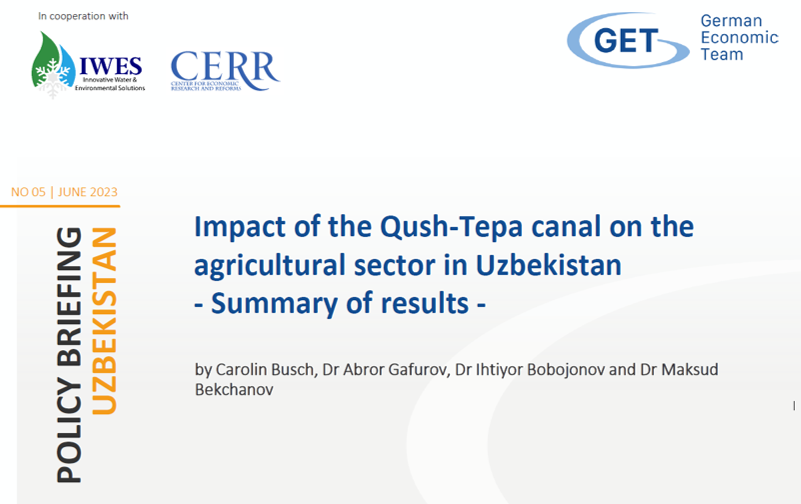

Executive Summary »
Construction of the Qush-Tepa canal in Afghanistan will affect water availability in the Amu Darya river basin in Uzbekistan.
By 2030, the water reduction due to the canal and impact of climate change is expected to be 29.4% relative to 2022 » The impact of Qush-Tepa on water availability varies between regions and is smaller in Surkhandarya and Kashkadarya, which also take in water from sources other than Amu Darya »
Reduced water availability due to Qush-Tepa and climate change will have implications for the agricultural sector in Uzbekistan, which consumes 90% of water in Uzbekistan »
Usable cropland is expected to decrease by 18.9% in the Amu Darya basin (in a 25% water intake from Qush-Tepa scenario upon completion of the canal).
With current land allocation policies, all crops except cotton and wheat will decline, with largest decline for the area under rice cultivation »
Value added from cropping will also decline in this scenario, by 12.9% for the Amu Darya basin, which would account for 6.2% of current national cropping value added and 0.7% of 2022 GDP »
Employment is reduced by up to 250,000 jobs in the Amu Darya basin in the 25% intake scenario » To address these negative impacts, recommended policies include:
– Targeted subsidies for adoption of efficient irrigation technologies – Extension services to increase awareness and knowledge of efficient irrigation among farmers – Flexible water tariffs at regional level instead of quotas, adequately priced to reflect scarcity
– Liberalisation of land allocation policies for wheat and cotton to allow for efficient crop allocation
– Regional development policies to mitigate negative impacts of water scarcity
to read the full document please click on
/wp-content/uploads/2026/07/Impact%20of%20Qush%20Tepe%20Canal.pdf
^
Executive Summary »
Construction of the Qush-Tepa canal in Afghanistan will affect water availability in the Amu Darya river basin in Uzbekistan.
By 2030, the water reduction due to the canal and impact of climate change is expected to be 29.4% relative to 2022 » The impact of Qush-Tepa on water availability varies between regions and is smaller in Surkhandarya and Kashkadarya, which also take in water from sources other than Amu Darya »
Reduced water availability due to Qush-Tepa and climate change will have implications for the agricultural sector in Uzbekistan, which consumes 90% of water in Uzbekistan »
Usable cropland is expected to decrease by 18.9% in the Amu Darya basin (in a 25% water intake from Qush-Tepa scenario upon completion of the canal).
With current land allocation policies, all crops except cotton and wheat will decline, with largest decline for the area under rice cultivation »
Value added from cropping will also decline in this scenario, by 12.9% for the Amu Darya basin, which would account for 6.2% of current national cropping value added and 0.7% of 2022 GDP »
Employment is reduced by up to 250,000 jobs in the Amu Darya basin in the 25% intake scenario » To address these negative impacts, recommended policies include:
– Targeted subsidies for adoption of efficient irrigation technologies – Extension services to increase awareness and knowledge of efficient irrigation among farmers – Flexible water tariffs at regional level instead of quotas, adequately priced to reflect scarcity
– Liberalisation of land allocation policies for wheat and cotton to allow for efficient crop allocation
– Regional development policies to mitigate negative impacts of water scarcity
to read the full document please click on
/wp-content/uploads/2026/07/Impact%20of%20Qush%20Tepe%20Canal.pdf
^
