
Thirty Years of COP Decisions: An Implementation Assessment from a Water Security Perspective
Dursun Yıldız
Hydropolitics Association (SPD), Türkiye
2 November 2026
Since the first Conference of the Parties (COP1) in Berlin in 1995, the international climate process has established a substantial legal and institutional framework for global climate governance. The Kyoto Protocol, Paris Agreement, Green Climate Fund, and Fund for Responding to Loss and Damage represent major achievements of this process.
However, a significant gap remains between international climate commitments and their implementation through measurable outcomes.
This implementation gap is particularly important in the field of water security. Although many impacts of climate change are transmitted through the hydrological cycle, water security has not yet become a sufficiently prominent, independently measurable implementation priority within global climate governance.
COP31 Antalya presents an opportunity to strengthen the transition from climate commitments to practical implementation.
The credibility of COP31 as an “Implementation COP” should be assessed not by the number of new commitments announced, but by its capacity to accelerate funded, measurable and accountable climate actions.
1. What Has Been Implemented from Previous COP Decisions?
Previous COP meetings have produced important achievements:
- COP3 Kyoto (1997): The Kyoto Protocol entered into force and established binding emission reduction obligations for participating developed countries, alongside market-based mechanisms.
- COP16 Cancún (2010): The Green Climate Fund was established and subsequently began financing climate-related projects in developing countries.
- COP21 Paris (2015): The Paris Agreement entered into force, creating a framework for nationally determined contributions (NDCs), adaptation and transparency.
- COP24 Katowice (2018): The Paris Agreement Rulebook established detailed arrangements for reporting and monitoring implementation.
- COP27 Sharm El-Sheikh (2022): Parties agreed to establish funding arrangements for responding to loss and damage. Operational arrangements were adopted at COP28.
- COP28 Dubai (2023): The first Global Stocktake was concluded, including a call to transition away from fossil fuels in energy systems and accelerate renewable energy deployment.
- COP29 Baku (2024): A new collective quantified climate finance goal of at least USD 300 billion annually by 2035 for developing countries was adopted.
These achievements demonstrate that COP decisions can generate legal obligations, institutional arrangements, national policies and financial mechanisms.
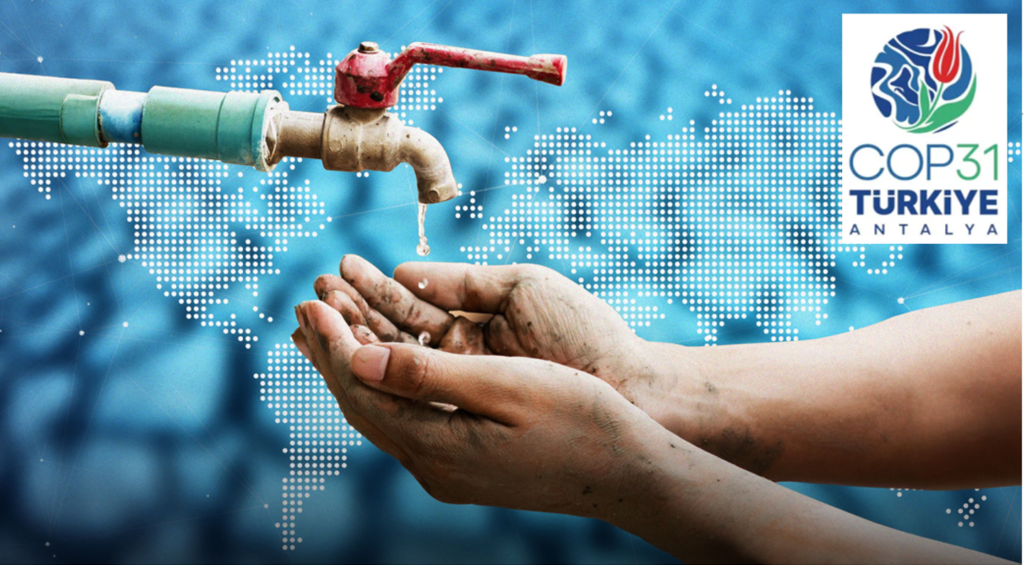
These are significant decisions. However, the adoption of these decisions does not mean that the targeted climate outcomes have been achieved. There has been a failure to effectively implement the decisions that were taken.
Nevertheless, institutional progress does not necessarily translate into sufficient environmental or social outcomes.
2. The Water Security Implementation Gap
Climate change affects water security through changes in precipitation patterns, prolonged droughts, intensified floods, groundwater stress, agricultural production risks and ecosystem degradation.
Despite growing recognition of these risks, several implementation gaps remain.
First, climate adaptation finance directed towards water security is not consistently tracked through sufficiently comparable and transparent indicators.
Second, many water-related adaptation investments are evaluated primarily through expenditure and infrastructure delivery rather than demonstrated improvements in climate resilience.
Third, transboundary river basins remain particularly vulnerable to climate-related risks because of fragmented institutions, insufficient data sharing and limited coordinated adaptation investments.
Fourth, the Water–Energy–Food–Ecosystems (WEFE) Nexus approach has not yet been systematically incorporated into climate investment planning and project appraisal.
Finally, climate finance mechanisms need stronger links to equitable access to safe water, particularly for vulnerable communities.
Water security should therefore be recognized not merely as a sector affected by climate change, but as a strategic foundation for successful climate adaptation and sustainable development.
3. Five Policy Priorities for COP31 Antalya
Priority 1 — Establish a Water Security Implementation Framework
COP31 should encourage the development of a voluntary framework connecting water security targets with existing NDCs, National Adaptation Plans (NAPs), institutional responsibilities and implementation timelines.
The framework should build on existing UNFCCC processes rather than create unnecessary reporting obligations.
Priority 2 — Strengthen Water Adaptation Finance Tracking
Water-related adaptation finance should be identified and monitored more transparently within existing international climate finance reporting systems.
Financial commitments, contracted funding and actual disbursements should be reported separately, with safeguards against double counting.
Priority 3 — Accelerate Transboundary Basin Climate Cooperation
COP31 should promote practical cooperation among riparian countries through joint hydrological monitoring, early warning systems, shared climate risk assessments and basin-scale adaptation programmes.
Such cooperation can contribute to regional resilience, conflict prevention and sustainable development.
Priority 4 — Integrate the WEFE Nexus into Climate Investments
The WEFE Nexus approach should become a practical analytical framework for assessing the interdependencies among water security, renewable energy, food production and ecosystem protection.
Nexus-based assessments can improve investment prioritization, identify trade-offs and strengthen the long-term sustainability of climate adaptation projects.
Priority 5 — Measure Water Security Outcomes
The performance of water-related climate projects should be assessed through measurable outcomes rather than financial inputs alone.
Relevant indicators may include water service reliability, populations with reduced exposure to climate risks, avoided drought and flood losses, ecosystem conditions and improved access for vulnerable communities.
4. How Should COP31 Implementation Success Be Measured?
A water-focused COP31 implementation assessment should consider the following indicators:
- Actual financial disbursements: Climate adaptation funding disbursed for water-related projects.
- Investment readiness: Number and value of water security projects with confirmed financing, responsible institutions and implementation schedules.
- Resilience outcomes: Populations and essential water services benefiting from demonstrated reductions in climate vulnerability.
- Transboundary cooperation: River basins with functioning joint climate adaptation mechanisms.
- WEFE Nexus integration: Investment programmes incorporating documented water–energy–food–ecosystems assessments.
- Accountability: Availability of independently verifiable monitoring and evaluation results.
These indicators should distinguish between commitments, implementation activities and verified outcomes.
5. Conclusions and Call to Action
Over more than three decades, the COP process has established much of the institutional architecture required for international climate cooperation.
The central challenge is now to translate existing commitments into timely, adequately financed and measurable implementation.
Water security must become a central component of this transition.
Progress towards climate adaptation, food security, energy security, ecosystem protection and climate justice depends fundamentally on resilient and equitable water systems.
COP31 Antalya can contribute to a new phase of international climate governance by strengthening implementation mechanisms that connect climate policy with tangible benefits for communities and ecosystems.
The Hydropolitics Association calls on COP31 to advance water security as a measurable climate implementation priority, supported by accessible finance, basin-scale cooperation and transparent accountability mechanisms.
Core Policy Message
“From COP Decisions to Measurable Water Security Outcomes.”
There can be no credible Climate Implementation COP without measurable progress on water security.
References
- UNFCCC (2015). Paris Agreement.
- UNFCCC (2023). Decision 1/CMA.5: Outcome of the First Global Stocktake.
- UNFCCC (2024). Decision 1/CMA.6: New Collective Quantified Goal on Climate Finance.
- OECD (2026). Climate Finance Provided and Mobilised by Developed Countries.
- UNEP (2025). Emissions Gap Report.
- UNEP (2025). Adaptation Gap Report.
- UNECE (2015). Reconciling Resource Uses in Transboundary Basins: Assessment of the Water-Food-Energy-Ecosystems Nexus.