


Dursun Yıldız
Director
Hydropolitics Academy
dursunyildiz001@gmail.com
SUMMARY
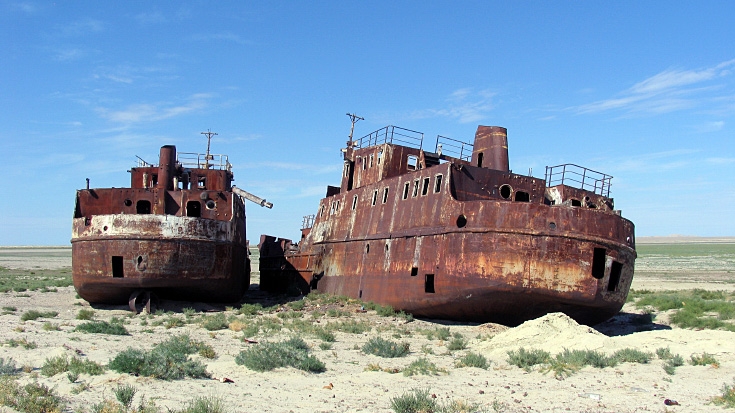
In 2011, Together with Ambassador (R) and Hydropolitical Academy founding Member M. Nuri Yildirim we made a technical trip to Central Asia .In this trip 2 hours after we left Kızılorda city to reach Aral Sea , we began to witness the great damage caused to the environment by drying a lake along the dirt road. As the water was drawn from the sea, it also took away the ecological balance. Because of the strong winds in the region, salt and drugs in the vicinity of the lake spread very alarmingly, this problem was felt in the capital of Uzbekistan, Tashkent, which is 500 km away.In this article I’m looking for an answer to the question of whether the Aral Sea will go back or not.
Keywords : Aral Sea, Environmental Disater,
- Introduction
Since the 1960s, the Aral Sea has been severely shrunk due to the excessive use of water resources that feed the lake in the period of USSR for agricultural irrigation. This decrease in the amount of water in the Aral Lake brought many ecological problems for the lake and its surroundings. The area of 33.000 km2 in Aral Lake is completely dried and the mineral content in its water is increased. The lake ecosystem is almost completely destroyed.
In the period between 1911 and 1960, an annual average of 56 billion m3 of water was spilled on the Aral Sea. Since the mid – 1980s, the decline in the Aral Sea water volume has accelerated. It was divided into two part in December 1987. The depth of the small Aral to the north dropped to 12 m. The depth of the Great Aral in the south dropped to 23 m. The Aral Lake, on this date, shrank by 74% in area and 84% in volume .
The area of Aral Lake, which was 67 500 km2 in 1960, decreased to 17 200 km2 in 2003. The most populous countries in the region are also the most industrialized countries. For this reason, these countries need important water to feed their populations as well as to provide water to their industries.
to read full articles please click on
^
Dursun Yıldız
Director
Hydropolitics Academy
dursunyildiz001@gmail.com
SUMMARY
In 2011, Together with Ambassador (R) and Hydropolitical Academy founding Member M. Nuri Yildirim we made a technical trip to Central Asia .In this trip 2 hours after we left Kızılorda city to reach Aral Sea , we began to witness the great damage caused to the environment by drying a lake along the dirt road. As the water was drawn from the sea, it also took away the ecological balance. Because of the strong winds in the region, salt and drugs in the vicinity of the lake spread very alarmingly, this problem was felt in the capital of Uzbekistan, Tashkent, which is 500 km away.In this article I’m looking for an answer to the question of whether the Aral Sea will go back or not.
Keywords : Aral Sea, Environmental Disater,
- Introduction
Since the 1960s, the Aral Sea has been severely shrunk due to the excessive use of water resources that feed the lake in the period of USSR for agricultural irrigation. This decrease in the amount of water in the Aral Lake brought many ecological problems for the lake and its surroundings. The area of 33.000 km2 in Aral Lake is completely dried and the mineral content in its water is increased. The lake ecosystem is almost completely destroyed.
In the period between 1911 and 1960, an annual average of 56 billion m3 of water was spilled on the Aral Sea. Since the mid – 1980s, the decline in the Aral Sea water volume has accelerated. It was divided into two part in December 1987. The depth of the small Aral to the north dropped to 12 m. The depth of the Great Aral in the south dropped to 23 m. The Aral Lake, on this date, shrank by 74% in area and 84% in volume .
The area of Aral Lake, which was 67 500 km2 in 1960, decreased to 17 200 km2 in 2003. The most populous countries in the region are also the most industrialized countries. For this reason, these countries need important water to feed their populations as well as to provide water to their industries.
to read full articles please click on
^
