
World Water Day 2026: Where water flows, equality grows


20/03/2026
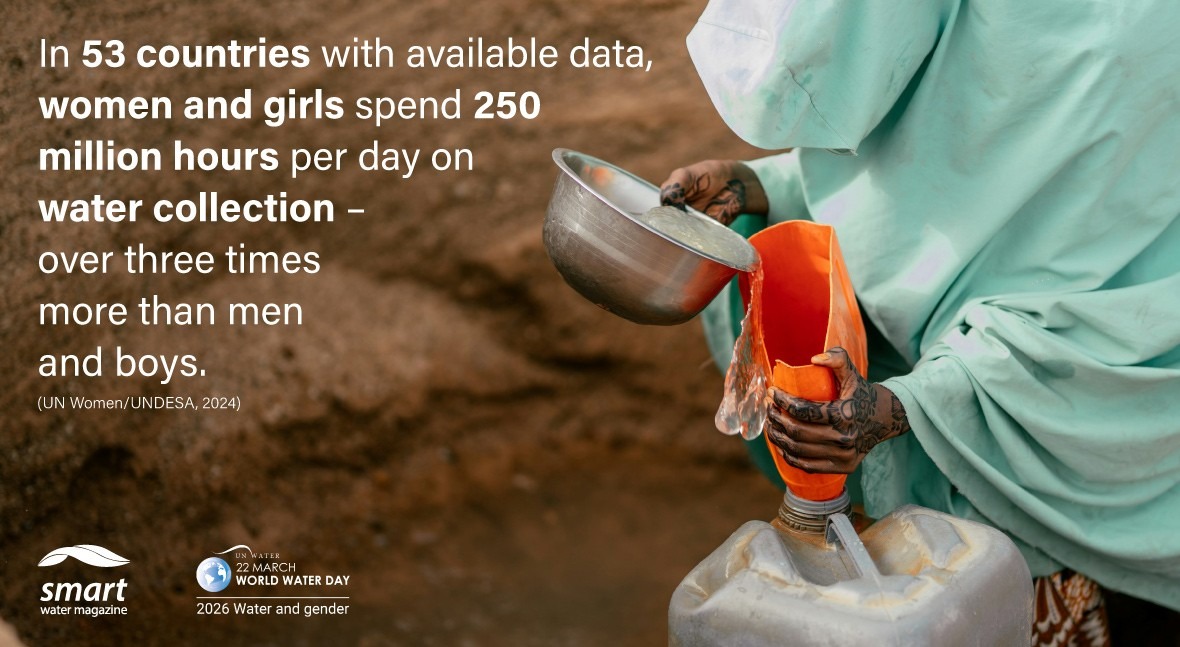
Every day, across 53 countries, women and girls spend a combined 250 million hours collecting water. These are not abstract figures. They are hours not spent in school, at work, at rest, or participating in public life.
For World Water Day 2026, the United Nations has placed this reality at the centre of its campaign under the slogan “Where water flows, equality grows,” and the message is as simple as it is powerful. The global water crisis does not affect everyone in the same way, and women carry a disproportionate share of its burden.
On 22 March, the water sector has an opportunity – and a responsibility – to take a hard look at itself
On this 22nd of March, the water sector has both an opportunity and a responsibility to confront this imbalance.
A crisis shaped by inequality
Recent 2026 data from UN-Water leaves little room for ambiguity. More than 2.1 billion people lack access to safely managed drinking water. Among them, women and girls are disproportionately affected. Over 1 billion women do not have access to safely managed water services, and 380 million live in areas of high or critical water stress, a number that could rise significantly by 2050. In two out of three households without water on the premises, it is women and girls who collect it.

Adolescent girls drop out of school when their schools lack safe or private toilets — a situation affecting 156 million young people aged 10 to 19 worldwide
The consequences are cumulative and predictable. Girls who accompany their mothers to fetch water miss school. Adolescent girls drop out of school when their schools lack safe or private toilets — a situation affecting 156 million young people aged 10 to 19 worldwide. Adult women see their health, safety and economic opportunities compromised. As Cecilia Sharp, Director of WASH and CEED at UNICEF, explains: “Every step a girl takes to collect water is a step away from learning, play and safety. Unsafe water, toilets, and handwashing at home rob girls of their potential, compromise their well-being, and perpetuate cycles of poverty. Responding to girls’ needs in the design and implementation of WASH programmes is critical to reaching universal access to water and sanitation and achieving gender equality and empowerment.”
Climate change acts as a multiplier of these inequalities. Droughts, floods and aquifer degradation affect the most vulnerable communities first and most severely, particularly those that rely on unmanaged water sources and where women carry almost the entire burden of securing water for domestic use.
The gender gap within the water sector itself
There is a second dimension to the problem that directly challenges those working in the water sector. Women are not only disproportionately affected by the water crisis, but they are also excluded from many of the spaces where solutions are designed.
The data is clear. Globally, women account for just over one-fifth of the water sector workforce, with far lower representation in leadership and in technical and strategic decision-making roles. According to a 2018–2019 World Bank survey of water and sanitation utilities in 28 countries, only 18 percent of workers were women, and 12 percent of utilities had no female managers at all. A survey of 173 water organisations in the Global South — including national water ministries, utilities, transboundary bodies and universities — found that women averaged just 26 percent of leadership positions, compared with 38 percent at mid-level and 36 percent at junior level.

The gap is equally acute in governance. As of 2023, around 15 percent of countries still had no mechanisms to ensure women’s effective participation or parity in decision-making and technical roles in the water sector. In Africa, only 17 percent of national water ministries are led by women, just one in eleven transboundary water organisations is headed by a woman, and only 13 percent of universities offering water science programmes have female leaders. The pipeline narrows early: women account for just 22 percent of engineering graduates globally, limiting the pool from which the sector can draw technical and managerial talent for decades to come.
This creates a clear contradiction. Women are often the primary managers of water at household and community level. They have direct knowledge of daily needs and constraints. Yet they remain largely absent from decisions on infrastructure, tariffs, pricing and investment priorities.
Research shows that this exclusion is not only inequitable but also inefficient. Around 14 percent of countries still lack mechanisms to ensure women’s equal participation in water governance. Evidence collected over decades, particularly from community based water management in Asia, sub Saharan Africa and Latin America, shows that when women are involved on equal terms, services are more inclusive, more sustainable and more effective.

What is already underway, and what remains to be done
The sector is not starting from zero. Utilities in the UK, the United States and Australia, for example, are beginning to demonstrate what progress looks like when it is backed by clear targets and institutional commitment, though the gap remains substantial.
In the UK, women make up around 30 percent of the energy and utilities workforce, compared to nearly 48 percent across the broader economy. Retention is emerging as a key challenge: the 2023 Inclusion Measurement Framework found that women accounted for 29.6 percent of those leaving the sector, a rate that exceeds recruitment, slowing overall progress. Against this backdrop, some utilities are leading the way. Severn Trent has welcomed 500 more women into its business since 2021 and received its highest ever score of 74 percent in the Bloomberg Gender-Equality Index, with women now heading its operational and technology teams at an executive level. In February 2024, the UK and US formalised a joint commitment through a Memorandum of Understanding to partner on the WaterWoman Project, a framework designed to accelerate gender parity across water utilities in both countries using shared accountability indicators.
Around 14 percent of countries still lack mechanisms to ensure women’s equal participation in water governance
In the United States, women account for around 15 percent of the water workforce, against a national average of nearly 47 percent across all occupations. Retention is a particular challenge: female engineers leave utilities at nearly twice the rate of their male counterparts. Yet some organisations are pushing back against this trend. American Water, the country’s largest publicly traded water and wastewater utility, has achieved 60 percent female representation on its board of directors. Moreover, Denver Water reports that women make up 29 percent of its workforce, with its chief of staff, chief financial officer and general counsel all women, and all four of its watershed planning experts female. In Los Angeles, the Department of Water and Power launched a dedicated career recruitment drive in 2024, specifically targeting women for skilled trade roles
In Australia, progress in some parts of the sector has been more pronounced. In Victoria, data collected from all state water corporations shows that 55 percent of non-executive directors are women, 46 percent of executive leadership roles are held by women, and the share of female Managing Directors has grown from just 5 percent in 2016 to 38.9 percent in 2025. Queensland-based Unitywater has gone further still: women now represent 50 percent of its board, 47 percent of leadership roles, and 37 percent of its total workforce. Its BOOST gender equity programme, piloted in 2024, produced a four percent rise in women in leadership in a single year and a 20 percent improvement in inclusive leadership behaviours, with better retention as a result. The utility has also eliminated its gender pay gap in like-for-like roles.

However, these examples remain exceptions. Progress remains constrained by structural barriers, and evidence suggests that without deliberate and sustained intervention, change will be slow. As the 2023 Inclusion Measurement Framework noted for the UK, the pipeline problem begins before the front door: women represent only 21 percent of applications to energy and utility roles.
At an international level, the World Water Day 2026 campaign calls for equal representation of women across all areas of water leadership, from infrastructure design and policy making to engineering, applied science, agricultural water management and community leadership. It also stresses the importance of involving men and boys as active participants in this process.
The United Nations World Water Development Report 2026, published by UNESCO on 22 March, focuses entirely on the relationship between water and gender. Its recommendations are directed not only at governments, but also at operators, consultancies, technology companies and river basin organisations. The report comes at a critical moment. With 2030 approaching, progress on SDG 6 is behind schedule, and the window for corrective action is narrowing.
Time is running out
At an international level, the World Water Day 2026 campaign calls for equal representation of women across all areas of water leadership
SDG 6, water and sanitation for all by 2030, has been lagging for years. SDG 5, gender equality, faces similar delays. The United Nations stresses that the two are closely linked and that progress on one depends on progress on the other.
There are four years left. In that time, the water sector must expand and modernise infrastructure, digitise networks, manage increasingly severe droughts, negotiate tariffs and design climate adaptation policies. These tasks will be harder and less effective if they are carried out without half of the available talent and without addressing the needs of those most affected by water scarcity.
“Where water flows, equality grows,” says the UN. The sector could extend this idea further. Where equality grows, water systems function better, and the solutions designed to manage them are more durable.
^
World Water Day 2026: Where water flows, equality grows

20/03/2026
Every day, across 53 countries, women and girls spend a combined 250 million hours collecting water. These are not abstract figures. They are hours not spent in school, at work, at rest, or participating in public life.
For World Water Day 2026, the United Nations has placed this reality at the centre of its campaign under the slogan “Where water flows, equality grows,” and the message is as simple as it is powerful. The global water crisis does not affect everyone in the same way, and women carry a disproportionate share of its burden.
On 22 March, the water sector has an opportunity – and a responsibility – to take a hard look at itself
On this 22nd of March, the water sector has both an opportunity and a responsibility to confront this imbalance.
A crisis shaped by inequality
Recent 2026 data from UN-Water leaves little room for ambiguity. More than 2.1 billion people lack access to safely managed drinking water. Among them, women and girls are disproportionately affected. Over 1 billion women do not have access to safely managed water services, and 380 million live in areas of high or critical water stress, a number that could rise significantly by 2050. In two out of three households without water on the premises, it is women and girls who collect it.
Adolescent girls drop out of school when their schools lack safe or private toilets — a situation affecting 156 million young people aged 10 to 19 worldwide
The consequences are cumulative and predictable. Girls who accompany their mothers to fetch water miss school. Adolescent girls drop out of school when their schools lack safe or private toilets — a situation affecting 156 million young people aged 10 to 19 worldwide. Adult women see their health, safety and economic opportunities compromised. As Cecilia Sharp, Director of WASH and CEED at UNICEF, explains: “Every step a girl takes to collect water is a step away from learning, play and safety. Unsafe water, toilets, and handwashing at home rob girls of their potential, compromise their well-being, and perpetuate cycles of poverty. Responding to girls’ needs in the design and implementation of WASH programmes is critical to reaching universal access to water and sanitation and achieving gender equality and empowerment.”
Climate change acts as a multiplier of these inequalities. Droughts, floods and aquifer degradation affect the most vulnerable communities first and most severely, particularly those that rely on unmanaged water sources and where women carry almost the entire burden of securing water for domestic use.
The gender gap within the water sector itself
There is a second dimension to the problem that directly challenges those working in the water sector. Women are not only disproportionately affected by the water crisis, but they are also excluded from many of the spaces where solutions are designed.
The data is clear. Globally, women account for just over one-fifth of the water sector workforce, with far lower representation in leadership and in technical and strategic decision-making roles. According to a 2018–2019 World Bank survey of water and sanitation utilities in 28 countries, only 18 percent of workers were women, and 12 percent of utilities had no female managers at all. A survey of 173 water organisations in the Global South — including national water ministries, utilities, transboundary bodies and universities — found that women averaged just 26 percent of leadership positions, compared with 38 percent at mid-level and 36 percent at junior level.
The gap is equally acute in governance. As of 2023, around 15 percent of countries still had no mechanisms to ensure women’s effective participation or parity in decision-making and technical roles in the water sector. In Africa, only 17 percent of national water ministries are led by women, just one in eleven transboundary water organisations is headed by a woman, and only 13 percent of universities offering water science programmes have female leaders. The pipeline narrows early: women account for just 22 percent of engineering graduates globally, limiting the pool from which the sector can draw technical and managerial talent for decades to come.
This creates a clear contradiction. Women are often the primary managers of water at household and community level. They have direct knowledge of daily needs and constraints. Yet they remain largely absent from decisions on infrastructure, tariffs, pricing and investment priorities.
Research shows that this exclusion is not only inequitable but also inefficient. Around 14 percent of countries still lack mechanisms to ensure women’s equal participation in water governance. Evidence collected over decades, particularly from community based water management in Asia, sub Saharan Africa and Latin America, shows that when women are involved on equal terms, services are more inclusive, more sustainable and more effective.
What is already underway, and what remains to be done
The sector is not starting from zero. Utilities in the UK, the United States and Australia, for example, are beginning to demonstrate what progress looks like when it is backed by clear targets and institutional commitment, though the gap remains substantial.
In the UK, women make up around 30 percent of the energy and utilities workforce, compared to nearly 48 percent across the broader economy. Retention is emerging as a key challenge: the 2023 Inclusion Measurement Framework found that women accounted for 29.6 percent of those leaving the sector, a rate that exceeds recruitment, slowing overall progress. Against this backdrop, some utilities are leading the way. Severn Trent has welcomed 500 more women into its business since 2021 and received its highest ever score of 74 percent in the Bloomberg Gender-Equality Index, with women now heading its operational and technology teams at an executive level. In February 2024, the UK and US formalised a joint commitment through a Memorandum of Understanding to partner on the WaterWoman Project, a framework designed to accelerate gender parity across water utilities in both countries using shared accountability indicators.
Around 14 percent of countries still lack mechanisms to ensure women’s equal participation in water governance
In the United States, women account for around 15 percent of the water workforce, against a national average of nearly 47 percent across all occupations. Retention is a particular challenge: female engineers leave utilities at nearly twice the rate of their male counterparts. Yet some organisations are pushing back against this trend. American Water, the country’s largest publicly traded water and wastewater utility, has achieved 60 percent female representation on its board of directors. Moreover, Denver Water reports that women make up 29 percent of its workforce, with its chief of staff, chief financial officer and general counsel all women, and all four of its watershed planning experts female. In Los Angeles, the Department of Water and Power launched a dedicated career recruitment drive in 2024, specifically targeting women for skilled trade roles
In Australia, progress in some parts of the sector has been more pronounced. In Victoria, data collected from all state water corporations shows that 55 percent of non-executive directors are women, 46 percent of executive leadership roles are held by women, and the share of female Managing Directors has grown from just 5 percent in 2016 to 38.9 percent in 2025. Queensland-based Unitywater has gone further still: women now represent 50 percent of its board, 47 percent of leadership roles, and 37 percent of its total workforce. Its BOOST gender equity programme, piloted in 2024, produced a four percent rise in women in leadership in a single year and a 20 percent improvement in inclusive leadership behaviours, with better retention as a result. The utility has also eliminated its gender pay gap in like-for-like roles.
However, these examples remain exceptions. Progress remains constrained by structural barriers, and evidence suggests that without deliberate and sustained intervention, change will be slow. As the 2023 Inclusion Measurement Framework noted for the UK, the pipeline problem begins before the front door: women represent only 21 percent of applications to energy and utility roles.
At an international level, the World Water Day 2026 campaign calls for equal representation of women across all areas of water leadership, from infrastructure design and policy making to engineering, applied science, agricultural water management and community leadership. It also stresses the importance of involving men and boys as active participants in this process.
The United Nations World Water Development Report 2026, published by UNESCO on 22 March, focuses entirely on the relationship between water and gender. Its recommendations are directed not only at governments, but also at operators, consultancies, technology companies and river basin organisations. The report comes at a critical moment. With 2030 approaching, progress on SDG 6 is behind schedule, and the window for corrective action is narrowing.
Time is running out
At an international level, the World Water Day 2026 campaign calls for equal representation of women across all areas of water leadership
SDG 6, water and sanitation for all by 2030, has been lagging for years. SDG 5, gender equality, faces similar delays. The United Nations stresses that the two are closely linked and that progress on one depends on progress on the other.
There are four years left. In that time, the water sector must expand and modernise infrastructure, digitise networks, manage increasingly severe droughts, negotiate tariffs and design climate adaptation policies. These tasks will be harder and less effective if they are carried out without half of the available talent and without addressing the needs of those most affected by water scarcity.
“Where water flows, equality grows,” says the UN. The sector could extend this idea further. Where equality grows, water systems function better, and the solutions designed to manage them are more durable.
^
