

The Global Threat of Drying Lands
Key Messages
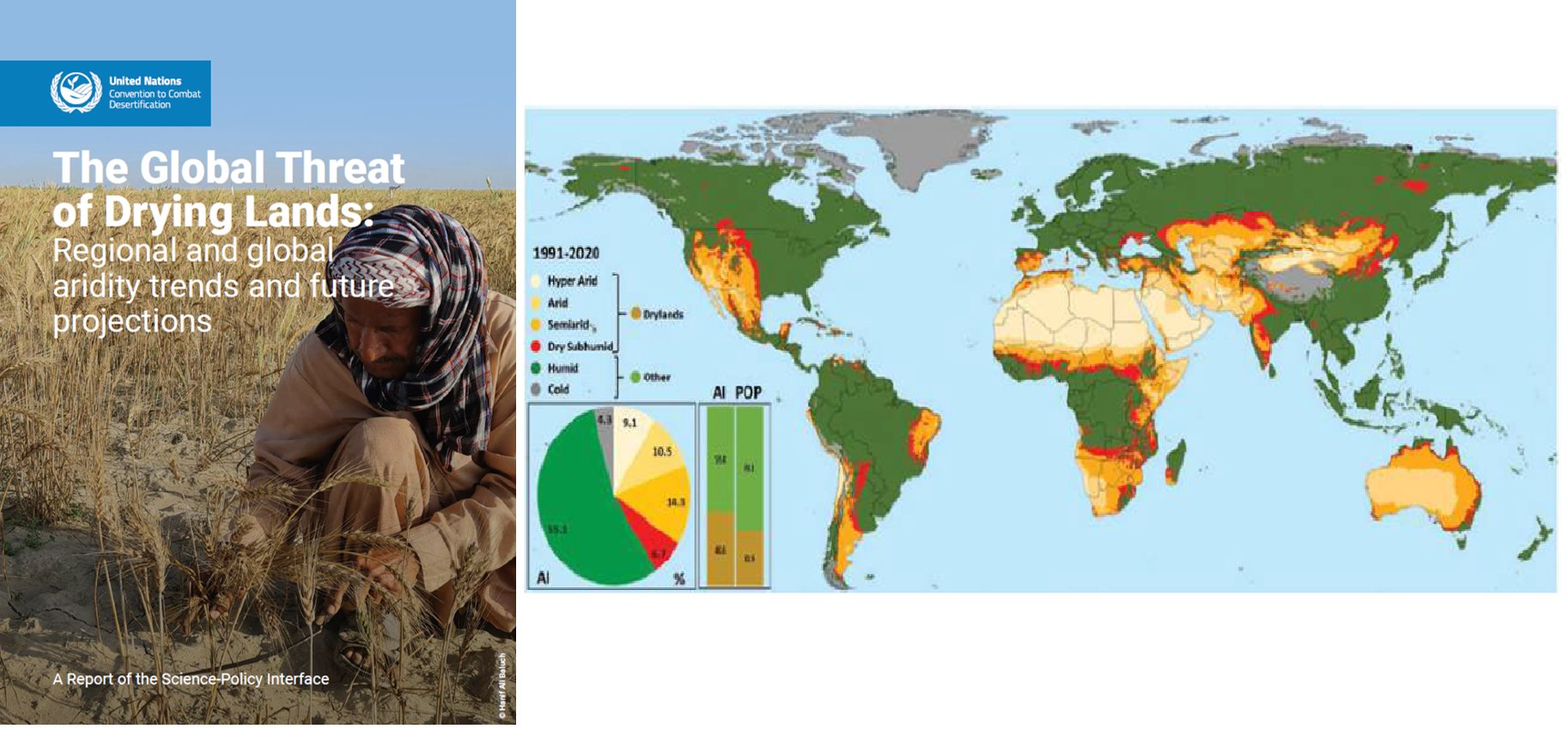
More than three-quarters of all land on Earth experienced a drier climate during the three decades leading up to 2020, compared to the previous 30-year period. Global drylands—areas in which precipitation is less than 65 percent of atmospheric evaporative demand—expanded by about 4.3 million km2, an area equal to about half the size of the continent of Australia/Oceania. Drylands now cover almost 41 per cent of global lands (excluding Antarctica).
Much of aridity’s recent rise can be attributed to human-caused climate change. If the world fails in efforts to curb greenhouse gas emissions into the future, another 3 per cent of the world’s humid areas are projected to transform into drylands by the end of this century.
People living in drylands have doubled in number in recent decades to 2.3 billion in 2020, up from 1.2 billion 30 years earlier. That is, those living in drylands comprised almost a third of all people on Earth (30.9 per cent) in 2020, compared to just over a fifth (22.5 per cent) in 1990.
About half of the world’s dryland inhabitants are found in Asia and Africa. The most densely populated drylands are in California, Egypt, eastern and northern Pakistan, large parts of India and north-eastern China.
Climate models suggest as many as 5 billion people could inhabit drylands by 2100 in a worst-case climate change scenario characterized by regional rivalries. Dryland inhabitants in this scenario would more than double the current number and would mean two in every five people on the planet live in drylands.
Hotspots showing significant dryland expansion include the western United States, the Yucatan Peninsula, north-eastern Brazil, north-western Argentina, the entire Mediterranean region, the northern side of the Black Sea, the Sahel, the Rift Valley, north-eastern South Africa, the bordering area between Russia and Kazakhstan, large parts of Mongolia and north-eastern China and south-eastern Australia.
Human-made greenhouse gas emissions have played a key role in the expansion of drylands, especially over the past three decades, according to climate simulations that show a pronounced global drying trend beginning in the 1950s and accelerating from the 1990s. Impacts from increasing aridification coupled with anthropogenic processes, lead to land degradation (and desertification) and water scarcity. These, in turn, can trigger cascading effects among many associated negative environmental and socioeconomic consequences, including food and water insecurity, poor soil fertility, losses in crop and plant productivity, biodiversity declines, ecosystem degradation, intense sand and dust storms, wildfires, poor health and large-scale human migration.
More than a fifth of all land could experience abrupt ecosystem transformations in response to rising aridity by the end of the century, according to recent projections. Increasing aridity is expected to play a role in larger and more intense wildfires in the climatealtered future—not least because of its impacts on tree deaths in semi-arid forests and the consequent growing availability of dry biomass for burning. Europe is likely to be especially affected.
More than two-thirds of all land on the planet (excluding Greenland and Antarctica) is projected to store less water by the end of the century if greenhouse gas emissions continue to rise even modestly. Aridity is considered the world’s largest single driver behind the degradation of agricultural systems, affecting 40 percent of Earth’s arable lands. Rising aridity has been blamed for a 12 percent decline in gross domestic product (GDP)
recorded for African countries between 1990–2015. Rising aridity’s impacts on poverty, water scarcity, land degradation and insufficient food production have been linked to increasing rates of sickness and death—especially among children and women around the world.
Rising aridity and drought play a key role in increasing human migration around the world— particularly in the hyperarid and arid areas of southern Europe, the Middle East and North Africa and southern Asia.
Quantifying future socioeconomic impacts can enhance equitable societal resilience. While some successful local and regional adaptation measures exist, transformational approaches are needed that blend traditional and local knowledge with evolving, up-to-date scientific understanding. Stakeholder engagement is crucial to enhance resilience to aridity, requiring sufficient financial resources, governance structures, partnerships, capacity-building initiatives, evaluation and learning, along with robust monitoring mechanisms.
Aridity-driven desertification—the degradation of land and terrestrial ecosystems in non-desert drylands—can result in a cascade of potentially devastating environmental and socioeconomic consequences.
While many aridification impacts in the world’s drylands are expected to intensify and expand to new areas in the climate-altered future, a better quantification of future socioeconomic impacts is needed to plan and implement adaptation measures that increase the resilience of vulnerable people.
Many poor, rural dryland populations have historically implemented sustainable practices to adapt their agriculture and pastoral activities to aridity, but intensifying aridification and the expansion of global drylands in the future will require transformational approaches that combine traditional knowledge with evolving scientific understanding and technical solutions.
Stakeholder engagement—supported by sufficient financial resources, governance structures and partnerships, capacity-building initiatives and robust monitoring and reporting resilience of societies to climate aridification.
Access to aridity information is essential for governments and institutions to address aridity’s impacts and to develop better adaptation tools. Information generated for this report has been included in an Aridity Visual Information Tool, available at https://global-aridity-monitoring-system.csic.es. The tool features the global spatial distribution of the average aridity index (AI)—the aridity indicator used in this report based on the ratio of precipitation to potential evapotranspiration over the medium to long term—and various aridity classes across two time periods (1961–1990 and 1991–2020).
The tool also includes aridity projections for 2100 based on two different emissions scenarios (SSP1-2.6 and SSP5-8.5) and highlights the uncertainties in these projections. It provides a monitoring feature that updates the AI annually, using data from the past five years.
The tool helps assess long-term changes in aridity by filtering out high-frequency climate variability, which is more closely related to drought events. All data within the system can be downloaded in various gridded formats or as time series.
The Aridity Visual Information Tool is also linked to the UNCCD Knowledge-Sharing Systems search tool (https://www.unccd.int/resources/knowledge-sharing-systems), which provides highly relevant information for assessing aridity at local to global scales and for developing socioeconomic and environmental aridity mitigation and adaptation efforts.
Source : Vicente-Serrano, S. M., N. G. Pricope, A. Toreti, E. Morán-Tejeda, J. Spinoni, A. Ocampo-Melgar, E. Archer, A. Diedhiou, T. Mesbahzadeh, N. H. Ravindranath, R. S. Pulwarty and S. Alibakhshi (2024). The Global Threat of Drying Lands: Regional and global aridity trends and future projections. A Report of the Science-Policy Interface. United Nations Convention to Combat
Desertification (UNCCD). Bonn, Germany.
Published in 2024 by United Nations Convention to Combat Desertification (UNCCD), Bonn, Germany
^
The Global Threat of Drying Lands
Key Messages
More than three-quarters of all land on Earth experienced a drier climate during the three decades leading up to 2020, compared to the previous 30-year period. Global drylands—areas in which precipitation is less than 65 percent of atmospheric evaporative demand—expanded by about 4.3 million km2, an area equal to about half the size of the continent of Australia/Oceania. Drylands now cover almost 41 per cent of global lands (excluding Antarctica).
Much of aridity’s recent rise can be attributed to human-caused climate change. If the world fails in efforts to curb greenhouse gas emissions into the future, another 3 per cent of the world’s humid areas are projected to transform into drylands by the end of this century.
People living in drylands have doubled in number in recent decades to 2.3 billion in 2020, up from 1.2 billion 30 years earlier. That is, those living in drylands comprised almost a third of all people on Earth (30.9 per cent) in 2020, compared to just over a fifth (22.5 per cent) in 1990.
About half of the world’s dryland inhabitants are found in Asia and Africa. The most densely populated drylands are in California, Egypt, eastern and northern Pakistan, large parts of India and north-eastern China.
Climate models suggest as many as 5 billion people could inhabit drylands by 2100 in a worst-case climate change scenario characterized by regional rivalries. Dryland inhabitants in this scenario would more than double the current number and would mean two in every five people on the planet live in drylands.
Hotspots showing significant dryland expansion include the western United States, the Yucatan Peninsula, north-eastern Brazil, north-western Argentina, the entire Mediterranean region, the northern side of the Black Sea, the Sahel, the Rift Valley, north-eastern South Africa, the bordering area between Russia and Kazakhstan, large parts of Mongolia and north-eastern China and south-eastern Australia.
Human-made greenhouse gas emissions have played a key role in the expansion of drylands, especially over the past three decades, according to climate simulations that show a pronounced global drying trend beginning in the 1950s and accelerating from the 1990s. Impacts from increasing aridification coupled with anthropogenic processes, lead to land degradation (and desertification) and water scarcity. These, in turn, can trigger cascading effects among many associated negative environmental and socioeconomic consequences, including food and water insecurity, poor soil fertility, losses in crop and plant productivity, biodiversity declines, ecosystem degradation, intense sand and dust storms, wildfires, poor health and large-scale human migration.
More than a fifth of all land could experience abrupt ecosystem transformations in response to rising aridity by the end of the century, according to recent projections. Increasing aridity is expected to play a role in larger and more intense wildfires in the climatealtered future—not least because of its impacts on tree deaths in semi-arid forests and the consequent growing availability of dry biomass for burning. Europe is likely to be especially affected.
More than two-thirds of all land on the planet (excluding Greenland and Antarctica) is projected to store less water by the end of the century if greenhouse gas emissions continue to rise even modestly. Aridity is considered the world’s largest single driver behind the degradation of agricultural systems, affecting 40 percent of Earth’s arable lands. Rising aridity has been blamed for a 12 percent decline in gross domestic product (GDP)
recorded for African countries between 1990–2015. Rising aridity’s impacts on poverty, water scarcity, land degradation and insufficient food production have been linked to increasing rates of sickness and death—especially among children and women around the world.
Rising aridity and drought play a key role in increasing human migration around the world— particularly in the hyperarid and arid areas of southern Europe, the Middle East and North Africa and southern Asia.
Quantifying future socioeconomic impacts can enhance equitable societal resilience. While some successful local and regional adaptation measures exist, transformational approaches are needed that blend traditional and local knowledge with evolving, up-to-date scientific understanding. Stakeholder engagement is crucial to enhance resilience to aridity, requiring sufficient financial resources, governance structures, partnerships, capacity-building initiatives, evaluation and learning, along with robust monitoring mechanisms.
Aridity-driven desertification—the degradation of land and terrestrial ecosystems in non-desert drylands—can result in a cascade of potentially devastating environmental and socioeconomic consequences.
While many aridification impacts in the world’s drylands are expected to intensify and expand to new areas in the climate-altered future, a better quantification of future socioeconomic impacts is needed to plan and implement adaptation measures that increase the resilience of vulnerable people.
Many poor, rural dryland populations have historically implemented sustainable practices to adapt their agriculture and pastoral activities to aridity, but intensifying aridification and the expansion of global drylands in the future will require transformational approaches that combine traditional knowledge with evolving scientific understanding and technical solutions.
Stakeholder engagement—supported by sufficient financial resources, governance structures and partnerships, capacity-building initiatives and robust monitoring and reporting resilience of societies to climate aridification.
Access to aridity information is essential for governments and institutions to address aridity’s impacts and to develop better adaptation tools. Information generated for this report has been included in an Aridity Visual Information Tool, available at https://global-aridity-monitoring-system.csic.es. The tool features the global spatial distribution of the average aridity index (AI)—the aridity indicator used in this report based on the ratio of precipitation to potential evapotranspiration over the medium to long term—and various aridity classes across two time periods (1961–1990 and 1991–2020).
The tool also includes aridity projections for 2100 based on two different emissions scenarios (SSP1-2.6 and SSP5-8.5) and highlights the uncertainties in these projections. It provides a monitoring feature that updates the AI annually, using data from the past five years.
The tool helps assess long-term changes in aridity by filtering out high-frequency climate variability, which is more closely related to drought events. All data within the system can be downloaded in various gridded formats or as time series.
The Aridity Visual Information Tool is also linked to the UNCCD Knowledge-Sharing Systems search tool (https://www.unccd.int/resources/knowledge-sharing-systems), which provides highly relevant information for assessing aridity at local to global scales and for developing socioeconomic and environmental aridity mitigation and adaptation efforts.
Source : Vicente-Serrano, S. M., N. G. Pricope, A. Toreti, E. Morán-Tejeda, J. Spinoni, A. Ocampo-Melgar, E. Archer, A. Diedhiou, T. Mesbahzadeh, N. H. Ravindranath, R. S. Pulwarty and S. Alibakhshi (2024). The Global Threat of Drying Lands: Regional and global aridity trends and future projections. A Report of the Science-Policy Interface. United Nations Convention to Combat
Desertification (UNCCD). Bonn, Germany.
Published in 2024 by United Nations Convention to Combat Desertification (UNCCD), Bonn, Germany
^
