
Dursun Yıldız
President, Hydropolitics Association (HPA)
24 November 2026
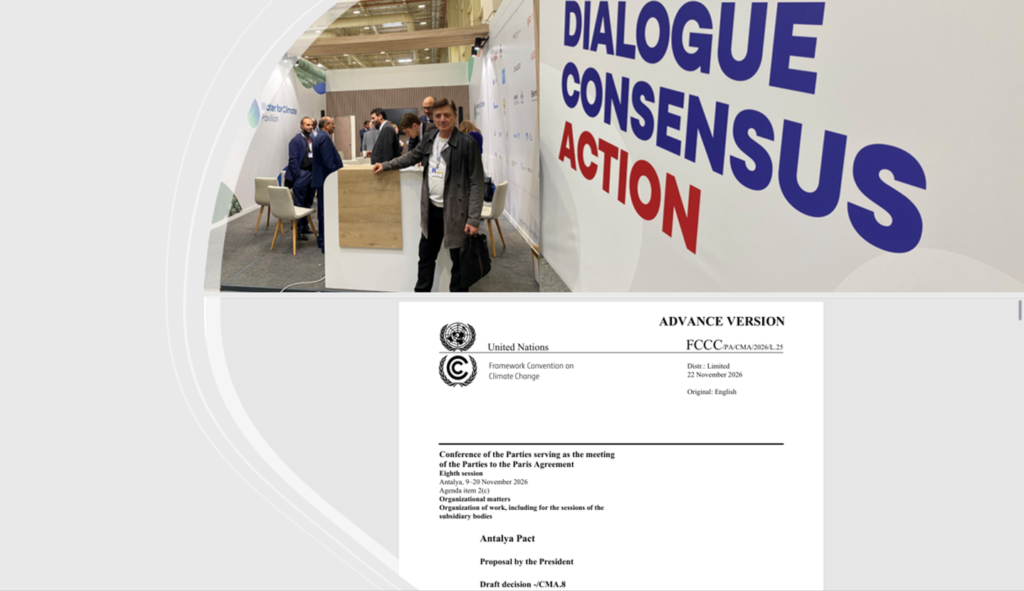
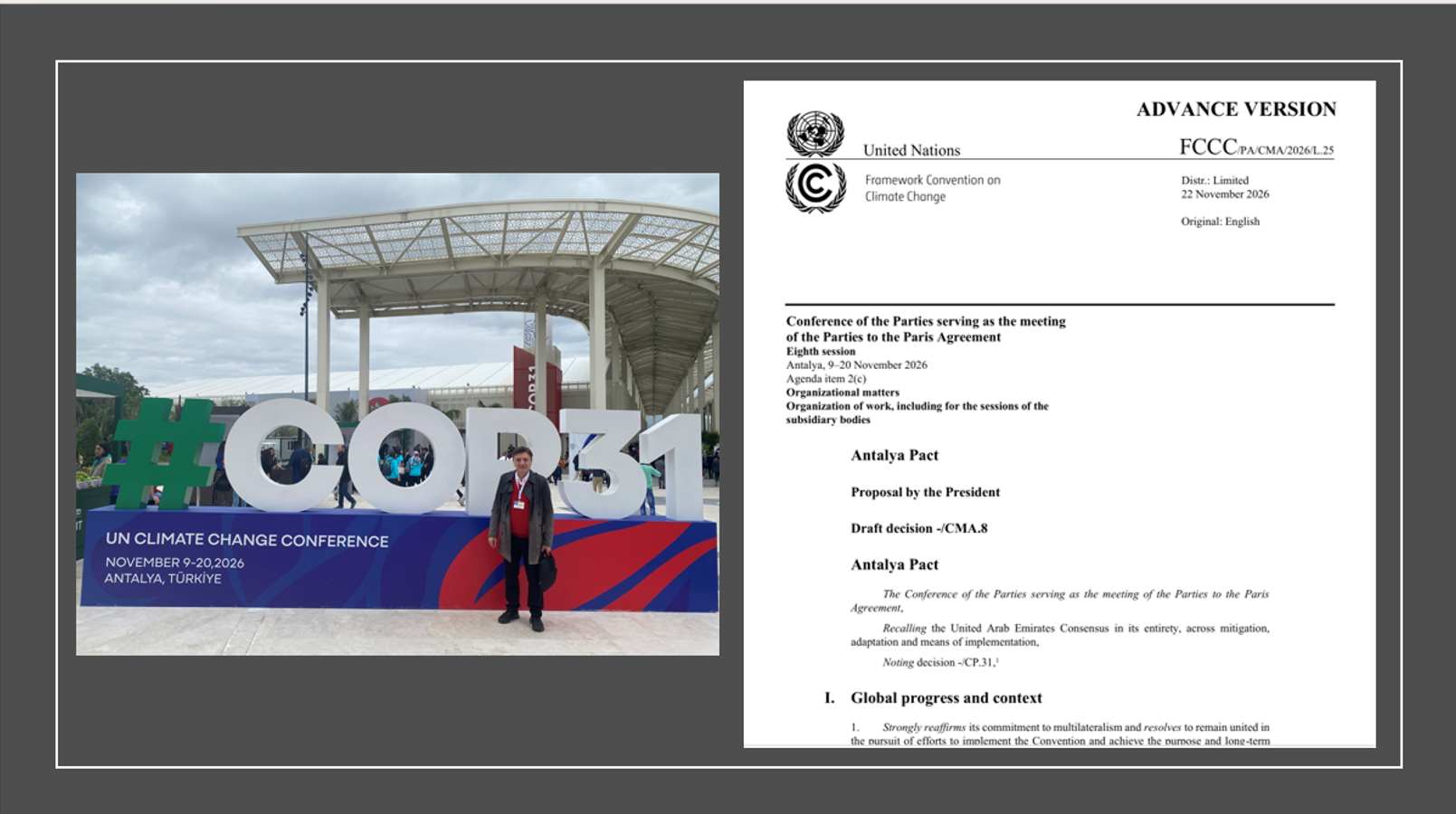
In the 12-page, 98-paragraph draft decision entitled Antalya Pact, published on 22 November 2026 within the framework of COP31 under document number FCCC/PA/CMA/2026/L.25, the word “water” appears only once.
Paragraph 84, in which the word water appears, addresses the disproportionate impacts of climate change on children and the importance of strengthening children’s access to essential services, including water and sanitation.
Water, at the Heart of the Climate Crisis, Is Missing from the Decision Text!
While the Antalya Pact’s last draft decision extensively addresses energy transition, electrification, climate finance, carbon markets, oceans, and forests, the following issues are not directly addressed:
- Water Security,
- Water Scarcity,
- Integrated Water Resources Management,
- Transboundary Water Cooperation,
- Water Justice.
Although the text mentions water-related issues such as drought-resilient livelihoods, vulnerable glacier-dependent communities, early warning systems, and ecosystem-based adaptation, it has not established an integrated policy framework for water security.
Can Climate Security Be Achieved Without Water Security?
A significant proportion of the impacts of climate change on societies, economies, and ecosystems manifests through the water cycle. Droughts, floods, groundwater depletion, and disruptions to agricultural production are among the most prominent examples. Energy transition is a fundamental component of climate change mitigation, while water security is a fundamental component of climate change adaptation.
Notably, the draft text, on which consensus could not be reached, sets a concrete global electrification target of 35% by 2035, while setting no comparable target for water security.
Consensus Was Not Reached, and Expectations Were Not Met
The COP31 Antalya Pact draft decision of 22 November 2026 fails to establish sufficiently concrete, measurable, and robust implementation mechanisms in response to the increasingly severe impacts of the global climate crisis.
The absence of a clear roadmap for transitioning away from fossil fuels, persistent uncertainties surrounding climate finance, the lack of an agreed baseline for tripling adaptation finance, and the imbalance in political priorities between climate change mitigation and adaptation constitute the principal shortcomings of the text.
Furthermore, while the text sets concrete targets for energy transition and electrification, it lacks an integrated policy framework for water security, agricultural production, food security, and drought management.
From the perspective of the Hydropolitics Association (SPD), the fact that the word “water” appears only once in this 12-page, 98-paragraph document is a striking indication of the insufficient integration of water security into global climate policies.
In its current form, although the draft text emphasises the implementation of existing commitments, it falls short of identifying concrete measures to close the structural implementation gap in global climate policies.
Water security must be placed at the centre of climate change adaptation policies, and concrete climate finance targets must be established for water infrastructure, sustainable water management, and equitable access to water.
The 2026 UN Water Conference should be regarded as an important opportunity to address this shortcoming in global climate policies.
In a world where the impacts of the climate crisis are experienced largely through water, the failure to place water at the centre of global climate policies represents a serious policy gap.
Climate resilience cannot be achieved without water security.
Source: UNFCCC (2026), Antalya Pact, Proposal by the President, Draft decision -/CMA.8, FCCC/PA/CMA/2026/L.25, 22 November 2026, 12 pages.