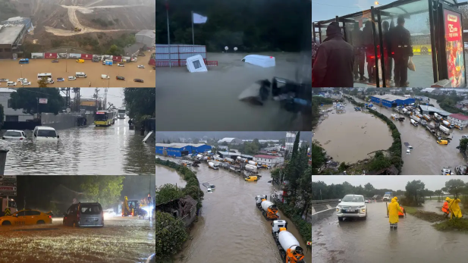

What Happened in Istanbul? Why Did It Happen?
Dursun Yıldız
President, Water Policy Association
October 16, 2026
Following the drought risk it faced last year, Istanbul is now grappling with the threat of floods and inundations. Recent rainfall has caused flooding in many parts of the city and led to the overflowing of stream beds. Once again, the precipitation followed the same natural drainage basins it has occupied for thousands of years. Streams such as the Alibey Creek in Arnavutköy, the Kağıthane Creek, the Ayazağa Creek in Sarıyer, and those near the Olympic Stadium in Başakşehir overflowed, causing extensive damage to their surroundings. Regrettably, there has also been a loss of life.
It has been scientifically proven that Istanbul’s stream systems have been adversely affected by unplanned development and land-use decisions. Despite this, haphazard urbanization and unregulated, unsupervised construction have persisted, increasing the risk that floods will escalate into full-scale disasters.
A Significant Meteorological Impact This Time
The rainfall that hit Istanbul this time was more prolonged, continuous, and intense. However, the recent floods in Istanbul are not merely the result of this extreme precipitation; they constitute a disaster that necessitates a critical examination of the opening of floodplains for construction, unplanned and haphazard urbanization, and existing zoning policies.
While the meteorological impact played a major role in turning this recent extreme rainfall into a disaster, zoning plan amendments were equally significant in the resulting damage. Extreme rainfall triggers flooding; haphazard urbanization and unregulated construction transform that flooding into a disaster.
Planning in Istanbul?
For a long time, Istanbul has functioned as a megacity largely devoid of urban planning. To enable the city to build resilience against disasters—such as earthquakes, floods, flash floods, droughts, and rising sea levels—a fundamental shift in thinking is required, spanning the entire process from the preparation of planning reports to their actual implementation. The concepts of “Istanbul” and “planning” must be brought together through an innovative and participatory approach. There is a critical need for both the institutional capacity and the political will to execute plans at various scales—ranging from regional, environmental, and watershed management plans to zoning, water, and wastewater master plans. Without taking this initial step, establishing order and resilience in Istanbul will be extremely difficult.
New disaster risk management is required for the “new normal”
The increasing intensity and frequency of extreme meteorological events in recent times indicate the emergence of a “new normal.” Consequently, ensuring Istanbul’s safety against floods and inundations cannot be achieved solely through stream channel improvements and rainwater drainage systems. It is essential to implement environmental planning that prioritizes the protection of water basins and floodplains, aligned with current hydrological realities. In this context, an integrated urban flood risk management approach must be adopted for Istanbul.
The first step is to prevent the opening of flood-prone areas to new construction. The second step involves restoring—wherever possible—natural stream floodplains that were previously narrowed, and establishing natural water-retention areas in suitable locations.
Another vital short-term measure is the expansion of rainwater infrastructure, the widening of insufficient cross-sections in stream beds, culverts, and bridge crossings, and the implementation of continuous monitoring.
To prevent Istanbul from descending into a state of unplanned and disorganized growth—under the mounting pressures of population increase, urban development, settlement patterns, climate change, and natural disaster risks—radical administrative and managerial measures are necessary.