

Executive summary
Survival and development indicators differ starkly between
the child born into an extremely fragile context and the child
born into a stable, protected and developed country context.
Children living in extremely fragile contexts are often more
than eight times worse off across water, sanitation and
hygiene (WASH) indicators. And they fare just as badly
on WASH-related indicators such as health, nutrition and
education. Today, more than 800 million children live in
58 fragile contexts, including more than 220 million children
living in 15 extremely fragile contexts.3 By 2030, more than
80 per cent of the world’s poorest people could be living in
fragile contexts.4 Action is needed now to close this gulf of
inequity before it widens further.
At the World Humanitarian Summit 2016, the then United
Nations Secretary-General Ban Ki-moon advocated for
unified support for the Agenda for Humanity, which builds
upon the 2030 Agenda for Sustainable Development and
links to the United Nations sustaining peace agenda.
The convergence of core responsibilities under these
agendas is particularly relevant in relation to Sustainable
Development Goal (SDG) 6: Ensure availability and
sustainable management of water and sanitation for all.5
This report is anchored on – and structured around – four
of the five core responsibilities set out in the Agenda for
Humanity.6 Unpacking each in turn, the report examines
how to realize – through strengthening the resilience of the
WASH sector in fragile and conflict-affected contexts – the
core responsibilities to:
• Leave no one behind
• Prevent and end conflicts
• Change people’s lives:
From delivering aid to ending need
• Invest in humanity.
Applying a humanitarian–development–peace lens,
the report explores the nature of WASH service delivery
in fragile and conflict-affected contexts, moving from the
discussion of a conceptual framework to the contribution
of tangible examples of best practice – from UNICEF and
partners – to the evidence base.
All partners are called on to support the following change
agenda, which is based on the examples of best practice:
Leave no one behind
Children in fragile and conflict-affected contexts experience
multiple vulnerabilities and challenges. To ensure that no child
is left behind calls for a human rights-based approach to WASH
service delivery that is both multisectoral, where relevant,
and transcends the humanitarian–development divide.
Governments, WASH sector, donors and other sectors are
called on to:
• realize the rights to water and sanitation for the entire
community (host communities, internally displaced
persons, refugees, migrants, women, girls and boys,
persons with disabilities, etc.) through inclusive policies,
planning and programming
• strengthen multisectoral collaboration where it is
relevant to securing multiple outcomes for children.
Prevent and end conflicts
Exclusion from services such as water and sanitation can
fuel grievances that can lead to violence. Understanding how
WASH interventions intersect with larger social, political,
economic, cultural and environmental factors is necessary
to uphold the ‘do no harm’ principle, prevent violence and
end conflicts.
• The WASH sector is called on to ensure that both
humanitarian and development WASH interventions
in fragile and conflict-affected contexts are
conflict-sensitive as a minimum requirement.
• Governments, WASH sector and private sector are called
on to adopt a more systematic and strategic approach
to leveraging WASH interventions to address the drivers
and dynamics of conflict and to sustain peace.
Change people’s lives: From delivering aid
to ending need
A change in approach from delivering aid to ending need
in fragile and conflict-affected contexts is a call to action
that will ensure that humanitarian needs are met,
and the effects of hazards are absorbed and reduced,
and disasters prevented, while protecting and accelerating
progress towards the SDGs for water and sanitation.
As such, all actors are called on to support the overarching
action to strengthen the resilience of the WASH sector.
Guided by the Framework for WASH Sector Resilience
in Fragile and Conflict-affected Contexts, the WASH sector is
to apply a risk-informed approach, ensuring that emergency
preparedness and prevention measures are incorporated
into policies and strategies; planning, monitoring
and review; institutional arrangements (service delivery,
coordination and accountability); and capacity development
(see above).
More specifically, this calls for actors to make
the following changes:
Policies and strategies
• Donors and WASH sector (international partners)
are called on to stay and invest during all phases and
especially during conflict.
• Government, donors, banks and WASH sector are
called on to:
– invest in preparedness and prevention early,
prior to the decline and collapse of the WASH sector
– prevent WASH systems from collapse in both
the acute and protracted conflict phases
– address long-term water security
– invest in renewable energy as a reliable, cost-effective
and environmentally sustainable solution for powering
water and sanitation systems during conflict.
Planning, monitoring and review
• Governments, WASH sector, Global WASH Cluster (GWC)
and Sanitation and Water for All (SWA) are called on to:
– integrate multi-year humanitarian and development
appeals and planning processes based on a
risk-informed approach
– advocate for more durable solutions from the onset
of an emergency
– integrate humanitarian WASH indicators into existing
government monitoring systems for development,
especially indicators related to the inclusion of
vulnerable groups
– strengthen knowledge management systems on
policy and programming across the humanitarian–
development–peace nexus.
• Donors and banks are called on to increase the global
humanitarian and development WASH envelope,
as well as multi-year, unearmarked and flexible funding.
Institutional arrangements: Service delivery,
coordination and accountability
• Government, WASH sector and private sector are called
on to invest in resilient service delivery models, such as
public–private partnerships, that can operate during conflict.
• Governments, WASH sector, GWC and SWA are called
on to strengthen:
– national and sub-national humanitarian and
development coordination structures
– governance (including government’s regulatory role)
and accountability in the WASH sector, while ensuring
accountability between government, service providers
and end users.
Capacity development
• Government, donors, banks, WASH sector and private
sector are called on to:
– professionalize the WASH sector through
the development of minimum benchmarks
for coordination and programming
– strengthen South-South learning.
Invest in humanity
New ways of working, new partnerships and innovative
financing mechanisms are required to bridge the gap in
financing WASH service delivery in fragile contexts to reach
the most vulnerable children.
• Governments are called on to develop a policy position:
– on who pays for what in WASH service delivery
– that ensures that service provider operation and
maintenance costs are fully covered as a prerequisite
for attracting commercial financing.
• Governments, donors, banks and key WASH sector
stakeholders are called on to:
– establish public–private partnerships as a way of
blending sources of finance and achieving results,
while recognizing that they are complex instruments
to set up and manage
– convene to solve the financing gap, specifically by:
> developing policy environments under which
service providers have more scope to borrow
> using concessional and grant financing to de-risk
projects and encourage commercial lenders to
actively participate in lending to service providers
> structuring investments in such a way as to
attract financing – for example, by establishing
public–private partnerships.
to read full report please click on
/wp-content/uploads/2026/07/Water-under-fire-volume-1-2019.pdf
^
Executive summary
Survival and development indicators differ starkly between
the child born into an extremely fragile context and the child
born into a stable, protected and developed country context.
Children living in extremely fragile contexts are often more
than eight times worse off across water, sanitation and
hygiene (WASH) indicators. And they fare just as badly
on WASH-related indicators such as health, nutrition and
education. Today, more than 800 million children live in
58 fragile contexts, including more than 220 million children
living in 15 extremely fragile contexts.3 By 2030, more than
80 per cent of the world’s poorest people could be living in
fragile contexts.4 Action is needed now to close this gulf of
inequity before it widens further.
At the World Humanitarian Summit 2016, the then United
Nations Secretary-General Ban Ki-moon advocated for
unified support for the Agenda for Humanity, which builds
upon the 2030 Agenda for Sustainable Development and
links to the United Nations sustaining peace agenda.
The convergence of core responsibilities under these
agendas is particularly relevant in relation to Sustainable
Development Goal (SDG) 6: Ensure availability and
sustainable management of water and sanitation for all.5
This report is anchored on – and structured around – four
of the five core responsibilities set out in the Agenda for
Humanity.6 Unpacking each in turn, the report examines
how to realize – through strengthening the resilience of the
WASH sector in fragile and conflict-affected contexts – the
core responsibilities to:
• Leave no one behind
• Prevent and end conflicts
• Change people’s lives:
From delivering aid to ending need
• Invest in humanity.
Applying a humanitarian–development–peace lens,
the report explores the nature of WASH service delivery
in fragile and conflict-affected contexts, moving from the
discussion of a conceptual framework to the contribution
of tangible examples of best practice – from UNICEF and
partners – to the evidence base.
All partners are called on to support the following change
agenda, which is based on the examples of best practice:
Leave no one behind
Children in fragile and conflict-affected contexts experience
multiple vulnerabilities and challenges. To ensure that no child
is left behind calls for a human rights-based approach to WASH
service delivery that is both multisectoral, where relevant,
and transcends the humanitarian–development divide.
Governments, WASH sector, donors and other sectors are
called on to:
• realize the rights to water and sanitation for the entire
community (host communities, internally displaced
persons, refugees, migrants, women, girls and boys,
persons with disabilities, etc.) through inclusive policies,
planning and programming
• strengthen multisectoral collaboration where it is
relevant to securing multiple outcomes for children.
Prevent and end conflicts
Exclusion from services such as water and sanitation can
fuel grievances that can lead to violence. Understanding how
WASH interventions intersect with larger social, political,
economic, cultural and environmental factors is necessary
to uphold the ‘do no harm’ principle, prevent violence and
end conflicts.
• The WASH sector is called on to ensure that both
humanitarian and development WASH interventions
in fragile and conflict-affected contexts are
conflict-sensitive as a minimum requirement.
• Governments, WASH sector and private sector are called
on to adopt a more systematic and strategic approach
to leveraging WASH interventions to address the drivers
and dynamics of conflict and to sustain peace.
Change people’s lives: From delivering aid
to ending need
A change in approach from delivering aid to ending need
in fragile and conflict-affected contexts is a call to action
that will ensure that humanitarian needs are met,
and the effects of hazards are absorbed and reduced,
and disasters prevented, while protecting and accelerating
progress towards the SDGs for water and sanitation.
As such, all actors are called on to support the overarching
action to strengthen the resilience of the WASH sector.
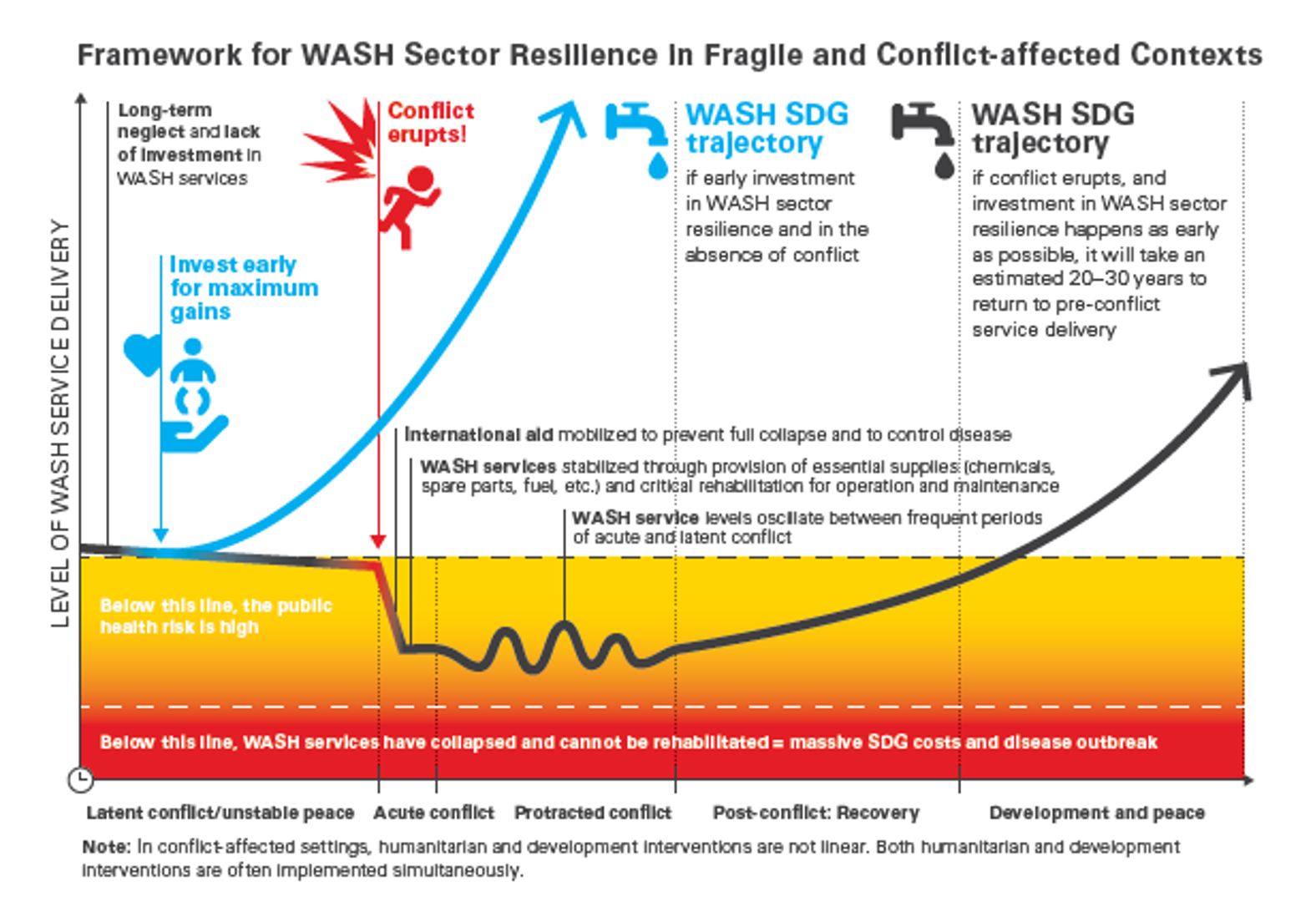
Guided by the Framework for WASH Sector Resilience
in Fragile and Conflict-affected Contexts, the WASH sector is
to apply a risk-informed approach, ensuring that emergency
preparedness and prevention measures are incorporated
into policies and strategies; planning, monitoring
and review; institutional arrangements (service delivery,
coordination and accountability); and capacity development
(see above).
More specifically, this calls for actors to make
the following changes:
Policies and strategies
• Donors and WASH sector (international partners)
are called on to stay and invest during all phases and
especially during conflict.
• Government, donors, banks and WASH sector are
called on to:
– invest in preparedness and prevention early,
prior to the decline and collapse of the WASH sector
– prevent WASH systems from collapse in both
the acute and protracted conflict phases
– address long-term water security
– invest in renewable energy as a reliable, cost-effective
and environmentally sustainable solution for powering
water and sanitation systems during conflict.
Planning, monitoring and review
• Governments, WASH sector, Global WASH Cluster (GWC)
and Sanitation and Water for All (SWA) are called on to:
– integrate multi-year humanitarian and development
appeals and planning processes based on a
risk-informed approach
– advocate for more durable solutions from the onset
of an emergency
– integrate humanitarian WASH indicators into existing
government monitoring systems for development,
especially indicators related to the inclusion of
vulnerable groups
– strengthen knowledge management systems on
policy and programming across the humanitarian–
development–peace nexus.
• Donors and banks are called on to increase the global
humanitarian and development WASH envelope,
as well as multi-year, unearmarked and flexible funding.
Institutional arrangements: Service delivery,
coordination and accountability
• Government, WASH sector and private sector are called
on to invest in resilient service delivery models, such as
public–private partnerships, that can operate during conflict.
• Governments, WASH sector, GWC and SWA are called
on to strengthen:
– national and sub-national humanitarian and
development coordination structures
– governance (including government’s regulatory role)
and accountability in the WASH sector, while ensuring
accountability between government, service providers
and end users.
Capacity development
• Government, donors, banks, WASH sector and private
sector are called on to:
– professionalize the WASH sector through
the development of minimum benchmarks
for coordination and programming
– strengthen South-South learning.
Invest in humanity
New ways of working, new partnerships and innovative
financing mechanisms are required to bridge the gap in
financing WASH service delivery in fragile contexts to reach
the most vulnerable children.
• Governments are called on to develop a policy position:
– on who pays for what in WASH service delivery
– that ensures that service provider operation and
maintenance costs are fully covered as a prerequisite
for attracting commercial financing.
• Governments, donors, banks and key WASH sector
stakeholders are called on to:
– establish public–private partnerships as a way of
blending sources of finance and achieving results,
while recognizing that they are complex instruments
to set up and manage
– convene to solve the financing gap, specifically by:
> developing policy environments under which
service providers have more scope to borrow
> using concessional and grant financing to de-risk
projects and encourage commercial lenders to
actively participate in lending to service providers
> structuring investments in such a way as to
attract financing – for example, by establishing
public–private partnerships.
to read full report please click on
/wp-content/uploads/2026/07/Water-under-fire-volume-1-2019.pdf
^
